- 01Access and Mobility Management FunctionAMF
- 02Unified Data ManagementUDM
- 03Policy Control FunctionPCF
- 04Network Repository FunctionNRF
- 05Non-3GPP Interworking FunctionN3IWF
- 06Security Edge Protection ProxySEPP
- 07Network Slice Selection FunctionNSSF
- 08Service Communication ProxySCP
- 09Application FunctionAF
- 10Location Management FunctionLMF
- 11Cell Broadcast CentreCBCF
- 12Gateway Mobile Location CentreGMLC
- 13Session Management FunctionSMF
- 14User Plane FunctionUPF
- 15SMS FunctionSMSF
- 16Equipment Identity RegisterEIR
Every 5G Standalone device registers, authenticates and moves through the AMF. The Ouroboros AMF does it on the same design as our 4G MME, and hands sessions to and from LTE over N26 so that subscribers keep their connection when 5G coverage ends.
A 5G Standalone launch rarely starts with national coverage. It starts with a few cities, a campus, or a factory floor, surrounded by an LTE network that carries everything else. Every time a subscriber walks out of the 5G footprint, the session must move to 4G, and back again when coverage returns.
When the 5G core and the 4G core come from different vendors, that boundary becomes an integration project: N26 interworking tested between two products, two support teams, two upgrade cycles. If it fails, subscribers lose their data session or have to re-register at every coverage edge, and the 5G launch looks worse than the LTE network it was meant to improve.

Registration and security
The AMF is the entry point of the 5G Standalone core. It terminates the N2 interface of the gNodeBs and the NAS signalling of the devices. It handles initial, mobility, periodic and emergency registrations and deregistrations, authenticates it with 5G AKA through the AUSF, retrieves its subscription from the UDM, checks its equipment identity with the 5G-EIR, and protects every NAS message with integrity and ciphering.
Sessions, SMS, policy and mobility
Once the device is registered, the AMF relays its PDU sessions to the SMF, its SMS to the SMSF, and applies the access, mobility and UE policies (URSP) of the PCF. It manages idle mode and paging, N2 handover, Xn path switch, and mobility between AMFs with UE context transfer. Network slicing is built in: the allowed NSSAI is computed from the slices subscribed in the UDM and requested by the device. After registration, the AMF updates the device configuration: network name, time zone and new 5G-GUTI.
N26 interworking with the 4G MME
The Ouroboros AMF shares its design with the Ouroboros 4G MME. UE contexts are stored in a database, and the two interwork over N26 in both directions, for idle mobility and for handover, with the Ouroboros SMF acting as a combined 4G/5G session anchor. The IP address and the session survive the move between generations. Wi-Fi access to the 5G core is handled through the Ouroboros N3IWF, an extension of our ePDG.
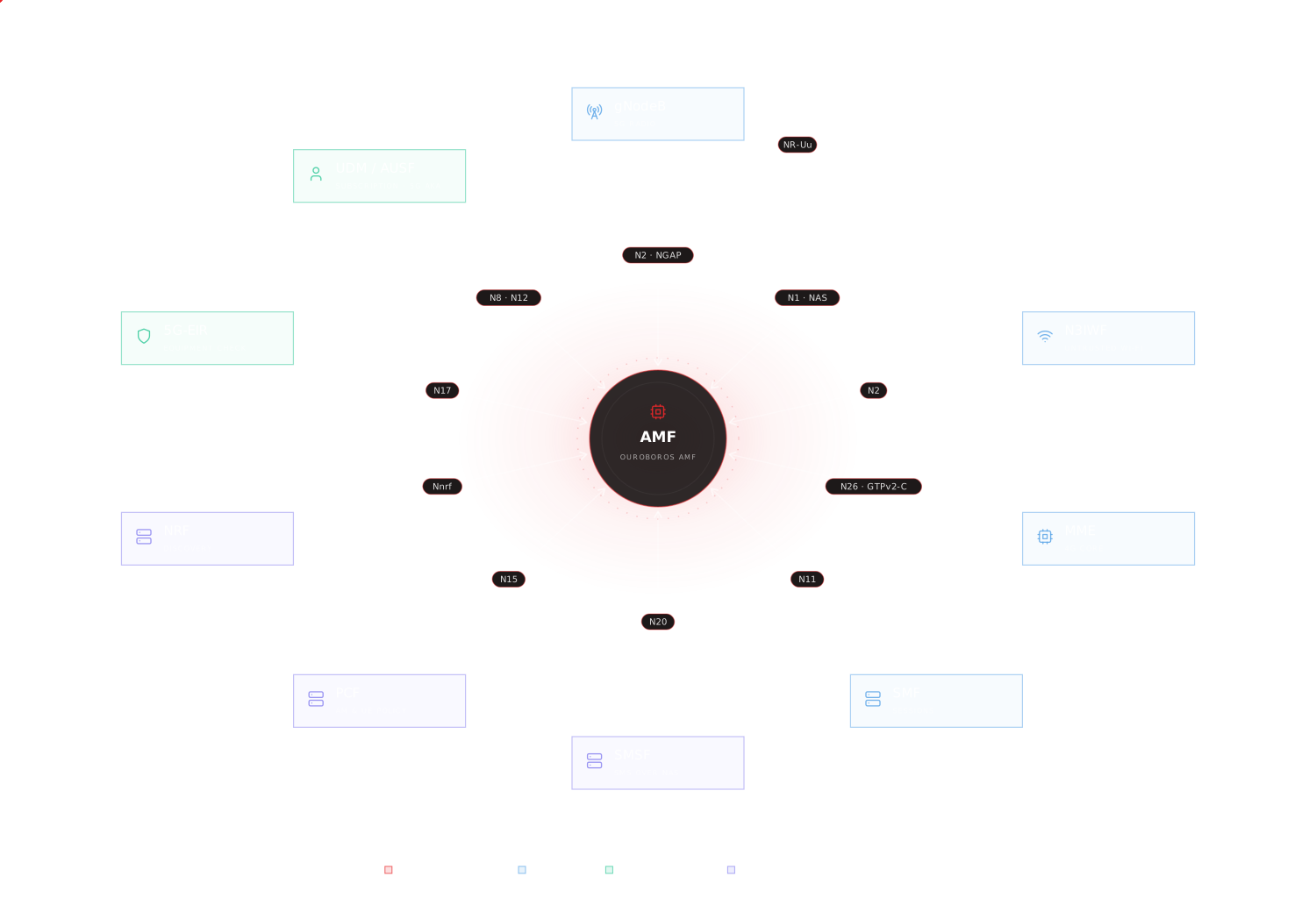
AMF — registration, mobility and N26 interworking in the 5G core
5G SA next to LTE, private 5G, MVNO cores, voice and SMS, equipment control — one mobility manager.
5G SA launch alongside an existing LTE network
The AMF and the Ouroboros MME interwork over N26. Subscribers move between 5G islands and LTE coverage without losing their session or their IP address, in idle mode and during handover.
Private 5G for industry and campuses
A factory, port or campus runs its own 5G SA core with the AMF on COTS hardware or in a private cloud. Network slicing separates critical machine traffic from general use on the same infrastructure.
5G for MVNOs with full core ownership
MVNOs who want 5G subscriber registration and authentication under their own control deploy the AMF with the Ouroboros UDM and AUSF, on the same subscriber database as their 2G, 3G and 4G services.
Voice and SMS on 5G SA
SMS over NAS is delivered through the SMSF. Wi-Fi calling on the 5G core reaches the AMF through the N3IWF, so that indoor coverage does not depend on the radio network.
Equipment control from day one
Every registration can trigger a 5G-EIR check, applying the same black, white and grey list policy as the older generations.

We've selected Ouroboros because it was the best company capable of fulfilling our need for a scalable and virtualised full MVNO platform. Moreover, the Ouroboros team is pragmatic, flexible and responsive.
Pascal Prot
CEO-CTO · Legos
N26 interworking with the Ouroboros MME
Idle mobility and handover between 5G SA and LTE, in both directions, with a combined SMF/PGW-C session anchor. Subscribers keep their session and IP address at every 5G coverage edge.
Same design as the 4G MME
The AMF follows the architecture of a mobility manager already proven on LTE, with UE contexts stored in a database. Operations teams find the same concepts, tools and records on 4G and 5G.
Full 5G security chain
5G AKA through the AUSF, SUCI deconcealment by the UDM, NAS integrity and ciphering, 5G-EIR equipment check. Subscriber identity is never sent in clear, and stolen devices are refused at registration.
Network slicing and UE policy
Allowed slices computed per device; access, mobility and URSP policies applied from the PCF. One core serves consumer, enterprise and machine traffic with distinct service levels.
Secured Service Based Interface
HTTP/2 over TLS with mutual authentication of the operator certificates, OAuth2 tokens and NRF discovery. The 5G core follows the security model regulators and enterprise customers expect.
Detail records on every procedure
Each registration, authentication and handover produces a detail record, alongside SNMP counters and Prometheus metrics. Troubleshooting a subscriber complaint starts from facts, not from packet captures.
IPv4, IPv6 and dual-stack
Every interface runs over IPv4, IPv6 or both. The element fits an IPv6 core or a mixed network without a separate configuration.
5G SA does not replace the LTE network; it lives next to it for years. The Ouroboros AMF was built for that reality: same design as our MME, N26 interworking with it in both directions, and one subscriber database shared with the UDM, HSS and HLR. The boundary between generations is inside one product family, not between two vendors.
The AMF runs on the AMTP platform, in production since 2004 and carrying more than 148 million subscribers across the portfolio. It deploys on bare metal, virtual machines, containers or public cloud.
OPEX rental is available, so a 5G pilot or a private network does not require a capital programme up front.

Tell us your LTE core, your 5G SA footprint and your launch date. We'll show how the AMF and N26 interworking keep subscribers connected across both, on OPEX or CAPEX.
 Product datasheet
5G Standalone · 5G Standalone
Access and Mobility Management Function (AMF)
Every 5G Standalone device registers, authenticates and moves through the AMF. The Ouroboros AMF does it on the same design as our 4G MME, and hands sessions to and from LTE over N26 so that subscribers keep their connection when 5G coverage ends.
In production since 2025 · 148M+ subscribers · 99.999% availability
5G coverage has edges. Your subscribers will cross them.
A 5G Standalone launch rarely starts with national coverage. It starts with a few cities, a campus, or a factory floor, surrounded by an LTE network that carries everything else. Every time a subscriber walks out of the 5G footprint, the session must move to 4G, and back again when coverage returns.
When the 5G core and the 4G core come from different vendors, that boundary becomes an integration project: N26 interworking tested between two products, two support teams, two upgrade cycles. If it fails, subscribers lose their data session or have to re-register at every coverage edge, and the 5G launch looks worse than the LTE network it was meant to improve.
From first registration to the LTE coverage edge.
Registration and security
The AMF is the entry point of the 5G Standalone core. It terminates the N2 interface of the gNodeBs and the NAS signalling of the devices. It handles initial, mobility, periodic and emergency registrations and deregistrations, authenticates it with 5G AKA through the AUSF, retrieves its subscription from the UDM, checks its equipment identity with the 5G-EIR, and protects every NAS message with integrity and ciphering.
Sessions, SMS, policy and mobility
Once the device is registered, the AMF relays its PDU sessions to the SMF, its SMS to the SMSF, and applies the access, mobility and UE policies (URSP) of the PCF. It manages idle mode and paging, N2 handover, Xn path switch, and mobility between AMFs with UE context transfer. Network slicing is built in: the allowed NSSAI is computed from the slices subscribed in the UDM and requested by the device. After registration, the AMF updates the device configuration: network name, time zone and new 5G-GUTI.
N26 interworking with the 4G MME
The Ouroboros AMF shares its design with the Ouroboros 4G MME. UE contexts are stored in a database, and the two interwork over N26 in both directions, for idle mobility and for handover, with the Ouroboros SMF acting as a combined 4G/5G session anchor. The IP address and the session survive the move between generations. Wi-Fi access to the 5G core is handled through the Ouroboros N3IWF, an extension of our ePDG.
AMF — registration, mobility and N26 interworking in the 5G core
How operators use it.
5G SA next to LTE, private 5G, MVNO cores, voice and SMS, equipment control — one mobility manager.
5G SA launch alongside an existing LTE network
The AMF and the Ouroboros MME interwork over N26. Subscribers move between 5G islands and LTE coverage without losing their session or their IP address, in idle mode and during handover.
Private 5G for industry and campuses
A factory, port or campus runs its own 5G SA core with the AMF on COTS hardware or in a private cloud. Network slicing separates critical machine traffic from general use on the same infrastructure.
5G for MVNOs with full core ownership
MVNOs who want 5G subscriber registration and authentication under their own control deploy the AMF with the Ouroboros UDM and AUSF, on the same subscriber database as their 2G, 3G and 4G services.
Voice and SMS on 5G SA
SMS over NAS is delivered through the SMSF. Wi-Fi calling on the 5G core reaches the AMF through the N3IWF, so that indoor coverage does not depend on the radio network.
Equipment control from day one
Every registration can trigger a 5G-EIR check, applying the same black, white and grey list policy as the older generations.
Specifications.
Inside the platform.
N26 interworking with the Ouroboros MME
Idle mobility and handover between 5G SA and LTE, in both directions, with a combined SMF/PGW-C session anchor. Subscribers keep their session and IP address at every 5G coverage edge.
Same design as the 4G MME
The AMF follows the architecture of a mobility manager already proven on LTE, with UE contexts stored in a database. Operations teams find the same concepts, tools and records on 4G and 5G.
Full 5G security chain
5G AKA through the AUSF, SUCI deconcealment by the UDM, NAS integrity and ciphering, 5G-EIR equipment check. Subscriber identity is never sent in clear, and stolen devices are refused at registration.
Network slicing and UE policy
Allowed slices computed per device; access, mobility and URSP policies applied from the PCF. One core serves consumer, enterprise and machine traffic with distinct service levels.
Secured Service Based Interface
HTTP/2 over TLS with mutual authentication of the operator certificates, OAuth2 tokens and NRF discovery. The 5G core follows the security model regulators and enterprise customers expect.
Detail records on every procedure
Each registration, authentication and handover produces a detail record, alongside SNMP counters and Prometheus metrics. Troubleshooting a subscriber complaint starts from facts, not from packet captures.
IPv4, IPv6 and dual-stack
Every interface runs over IPv4, IPv6 or both. The element fits an IPv6 core or a mixed network without a separate configuration.
5G SA does not replace the LTE network; it lives next to it for years. The Ouroboros AMF was built for that reality: same design as our MME, N26 interworking with it in both directions, and one subscriber database shared with the UDM, HSS and HLR. The boundary between generations is inside one product family, not between two vendors.
The AMF runs on the AMTP platform, in production since 2004 and carrying more than 148 million subscribers across the portfolio. It deploys on bare metal, virtual machines, containers or public cloud.
OPEX rental is available, so a 5G pilot or a private network does not require a capital programme up front.
Unified Data Management (UDM)
The AMF retrieves the subscription and registers with the UDM; the colocated AUSF authenticates every device.
Session Management Function (SMF)
PDU sessions requested by the device are relayed to the SMF, which also anchors the sessions moving to and from LTE.
vEPC (MME/SGW/PGW)
The Ouroboros MME is the 4G peer of the AMF over N26.
EIR
The 5G-EIR checks the equipment identity at registration.
Next step
Where does your 5G coverage end, and what happens to the session there?
Tell us your LTE core, your 5G SA footprint and your launch date. We'll show how the AMF and N26 interworking keep subscribers connected across both, on OPEX or CAPEX.