- 01Access and Mobility Management FunctionAMF
- 02Unified Data ManagementUDM
- 03Policy Control FunctionPCF
- 04Network Repository FunctionNRF
- 05Non-3GPP Interworking FunctionN3IWF
- 06Security Edge Protection ProxySEPP
- 07Network Slice Selection FunctionNSSF
- 08Service Communication ProxySCP
- 09Application FunctionAF
- 10Location Management FunctionLMF
- 11Cell Broadcast CentreCBCF
- 12Gateway Mobile Location CentreGMLC
- 13Session Management FunctionSMF
- 14User Plane FunctionUPF
- 15SMS FunctionSMSF
- 16Equipment Identity RegisterEIR
A subscriber moves from 4G to 5G SA and back several times a day. Their QoS, their data plan, and their VoLTE call should not change with the radio. The Ouroboros PCF runs in the same element as the PCRF: one rule set, one subscriber record, one policy across both generations.
Launching 5G SA usually means buying a PCF next to the existing PCRF. The 5G core gets its own policy engine, its own rule configuration, and often its own subscriber data. The same data plan is now written twice: once for Gx, once for N7. Every tariff change, every fair-usage threshold, every new application rule must be duplicated and kept identical.
When the two engines drift, subscribers notice. A throttling rule applies on 4G but not on 5G. A VoLTE call set up through the IMS loses its dedicated QoS when the session runs on a 5G PDU session. Policy that should follow the subscriber ends up following the radio access instead.

Session and mobility policy
The PCF decides how each 5G subscriber is served. When the SMF opens a PDU session, it asks the PCF over N7 which QoS, which charging and which gating rules apply. The PCF answers with PCC rules and QoS flows, then updates them during the session as usage, time or application events change the situation. Towards the AMF over N15, it sets the access and mobility policy (RFSP, UE-AMBR) and delivers URSP rules to the device: which traffic uses which DNN, which network slice, which session type.
PCRF and PCF in one element
The Ouroboros PCF runs in the same element as the Ouroboros PCRF. The 4G Gx and Rx sessions and the 5G sessions share the same rules, the same subscriber data, and the same session store. An Rx application session from the IMS, for example a VoLTE or VoWiFi call, applies to a 5G PDU session as well as to an LTE bearer. Application Functions connect over N5; the PCF turns their media descriptions into QoS flows and registers the session binding in the BSF.
Shared subscriber data and charging decisions
Subscriber profiles are read directly from the Ouroboros UDR, the repository shared with the HLR, HSS, UDM, OCS and CHF. A subscriber provisioned once has a policy profile on every generation. Charging decisions (rating groups, online or offline charging) are given to the SMF and applied by the Ouroboros CHF or any third-party CHF.
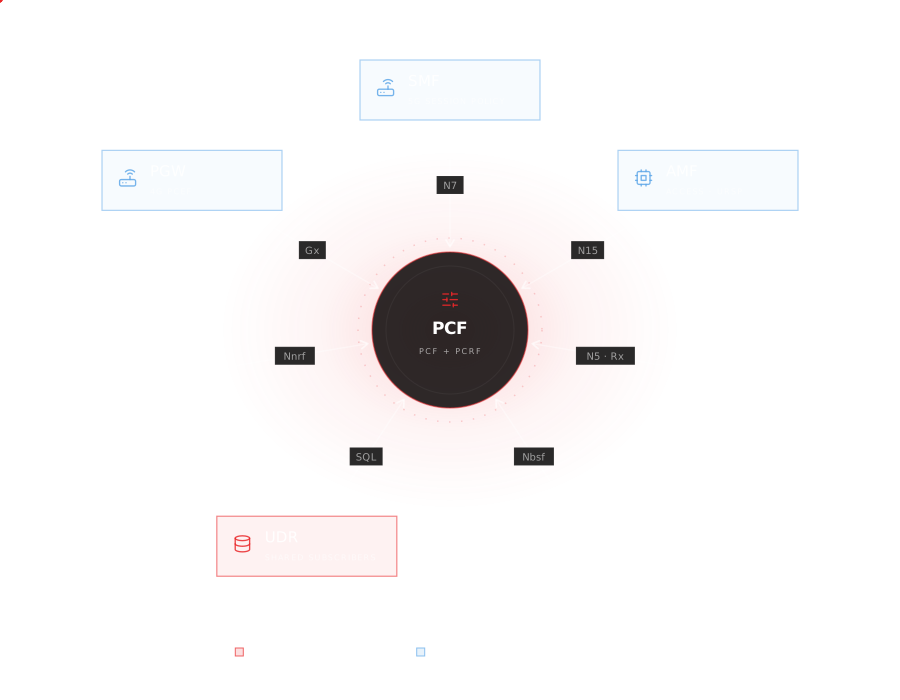
PCF — 4G and 5G policy in one element
4G and 5G under one policy, IMS on 5G, slicing, application control, fair usage — one rule set.
4G and 5G SA under one policy
An operator adds 5G SA to an existing LTE network. The PCRF rules already in production apply to 5G sessions without being rewritten. Subscribers keep the same plan, the same thresholds, and the same treatment whatever the access.
VoLTE and VoWiFi on 5G sessions
The IMS requests dedicated QoS over Rx or N5. The PCF applies it to the 5G PDU session through the SMF, so voice quality is maintained when the subscriber is attached to 5G SA.
Network slicing and URSP
URSP rules steer device traffic to the right slice and DNN: enterprise traffic on a dedicated slice, consumer traffic on the default one. The policy is defined centrally and delivered to the device through the AMF.
Application-aware charging and blocking
With the Ouroboros DPI option on the UPF, the PCF receives application start and stop events. An application can be blocked, zero-rated, or charged on its own rating group.
Fair usage and time-based offers
Rules combine usage counters, calendar, identity and flow criteria. A subscriber who exceeds the monthly volume is throttled; a night-time unlimited offer opens and closes automatically.

We've selected Ouroboros because it was the best company capable of fulfilling our need for a scalable and virtualised full MVNO platform. Moreover, the Ouroboros team is pragmatic, flexible and responsive.
Pascal Prot
CEO-CTO · Legos
4G PCRF and 5G PCF in one element
Gx, Rx, N7, N15 and N5 sessions run on the same engine with the same rules. A policy is written once and applies on every access. No second policy system to buy, configure, or keep aligned.
IMS sessions applied to 5G
An Rx or N5 application session can bind to a 5G PDU session as well as to an LTE bearer. VoLTE and VoWiFi keep their dedicated QoS when subscribers move to 5G SA.
Shared UDR
Policy profiles are read from the same repository as the HLR, HSS, UDM, OCS and CHF. One provisioning point. A plan change is visible to policy immediately, with no synchronisation interface.
URSP and slice steering
Route selection rules reach the device through the AMF. Slices and DNNs are used as designed, without manual device configuration.
DPI-driven application control
Application detection events from the Ouroboros UPF trigger rules in the PCF. Operators block, prioritise, or charge individual applications on their own rating group.
Rich rule criteria
Flow, URL, calendar, counters, identity and protocol criteria combine in one rule. Fair-usage, parental control, roaming passes and time-based offers deploy as configuration, not development.
Multi-tenant
Several MCC/MNC and number ranges share one node. MVNOs and multi-brand operators run separate policy on shared infrastructure.
IPv4, IPv6 and dual-stack
Every interface runs over IPv4, IPv6 or both. The element fits an IPv6 core or a mixed network without a separate configuration.
The hard part of 5G policy is not the new interfaces. It is keeping 5G consistent with the 4G network that carries most of the traffic today. The Ouroboros PCF removes that problem by running both generations in one element, on one rule set and one subscriber repository.
Operators already running the Ouroboros PCRF add 5G SA as an extension, not a new procurement. Operators on third-party platforms connect the PCF to any standards-compliant SMF, AMF, AF or CHF.
OPEX rental is available, so policy capacity can grow with the 5G subscriber base.

Tell us your current policy platform, your data offers, and your 5G SA timeline. We'll show how your 4G rules carry over to 5G in one element, on OPEX or CAPEX.
 Product datasheet
5G Standalone · 5G Standalone
Policy Control Function (PCF)
A subscriber moves from 4G to 5G SA and back several times a day. Their QoS, their data plan, and their VoLTE call should not change with the radio. The Ouroboros PCF runs in the same element as the PCRF: one rule set, one subscriber record, one policy across both generations.
In production since 2004 · 148M+ subscribers · 99.999% availability
Two policy engines, one subscriber
Launching 5G SA usually means buying a PCF next to the existing PCRF. The 5G core gets its own policy engine, its own rule configuration, and often its own subscriber data. The same data plan is now written twice: once for Gx, once for N7. Every tariff change, every fair-usage threshold, every new application rule must be duplicated and kept identical.
When the two engines drift, subscribers notice. A throttling rule applies on 4G but not on 5G. A VoLTE call set up through the IMS loses its dedicated QoS when the session runs on a 5G PDU session. Policy that should follow the subscriber ends up following the radio access instead.
One policy engine for 4G and 5G SA.
Session and mobility policy
The PCF decides how each 5G subscriber is served. When the SMF opens a PDU session, it asks the PCF over N7 which QoS, which charging and which gating rules apply. The PCF answers with PCC rules and QoS flows, then updates them during the session as usage, time or application events change the situation. Towards the AMF over N15, it sets the access and mobility policy (RFSP, UE-AMBR) and delivers URSP rules to the device: which traffic uses which DNN, which network slice, which session type.
PCRF and PCF in one element
The Ouroboros PCF runs in the same element as the Ouroboros PCRF. The 4G Gx and Rx sessions and the 5G sessions share the same rules, the same subscriber data, and the same session store. An Rx application session from the IMS, for example a VoLTE or VoWiFi call, applies to a 5G PDU session as well as to an LTE bearer. Application Functions connect over N5; the PCF turns their media descriptions into QoS flows and registers the session binding in the BSF.
Shared subscriber data and charging decisions
Subscriber profiles are read directly from the Ouroboros UDR, the repository shared with the HLR, HSS, UDM, OCS and CHF. A subscriber provisioned once has a policy profile on every generation. Charging decisions (rating groups, online or offline charging) are given to the SMF and applied by the Ouroboros CHF or any third-party CHF.
PCF — 4G and 5G policy in one element
How operators use it.
4G and 5G under one policy, IMS on 5G, slicing, application control, fair usage — one rule set.
4G and 5G SA under one policy
An operator adds 5G SA to an existing LTE network. The PCRF rules already in production apply to 5G sessions without being rewritten. Subscribers keep the same plan, the same thresholds, and the same treatment whatever the access.
VoLTE and VoWiFi on 5G sessions
The IMS requests dedicated QoS over Rx or N5. The PCF applies it to the 5G PDU session through the SMF, so voice quality is maintained when the subscriber is attached to 5G SA.
Network slicing and URSP
URSP rules steer device traffic to the right slice and DNN: enterprise traffic on a dedicated slice, consumer traffic on the default one. The policy is defined centrally and delivered to the device through the AMF.
Application-aware charging and blocking
With the Ouroboros DPI option on the UPF, the PCF receives application start and stop events. An application can be blocked, zero-rated, or charged on its own rating group.
Fair usage and time-based offers
Rules combine usage counters, calendar, identity and flow criteria. A subscriber who exceeds the monthly volume is throttled; a night-time unlimited offer opens and closes automatically.
Specifications.
Inside the platform.
4G PCRF and 5G PCF in one element
Gx, Rx, N7, N15 and N5 sessions run on the same engine with the same rules. A policy is written once and applies on every access. No second policy system to buy, configure, or keep aligned.
IMS sessions applied to 5G
An Rx or N5 application session can bind to a 5G PDU session as well as to an LTE bearer. VoLTE and VoWiFi keep their dedicated QoS when subscribers move to 5G SA.
Shared UDR
Policy profiles are read from the same repository as the HLR, HSS, UDM, OCS and CHF. One provisioning point. A plan change is visible to policy immediately, with no synchronisation interface.
URSP and slice steering
Route selection rules reach the device through the AMF. Slices and DNNs are used as designed, without manual device configuration.
DPI-driven application control
Application detection events from the Ouroboros UPF trigger rules in the PCF. Operators block, prioritise, or charge individual applications on their own rating group.
Rich rule criteria
Flow, URL, calendar, counters, identity and protocol criteria combine in one rule. Fair-usage, parental control, roaming passes and time-based offers deploy as configuration, not development.
Multi-tenant
Several MCC/MNC and number ranges share one node. MVNOs and multi-brand operators run separate policy on shared infrastructure.
IPv4, IPv6 and dual-stack
Every interface runs over IPv4, IPv6 or both. The element fits an IPv6 core or a mixed network without a separate configuration.
The hard part of 5G policy is not the new interfaces. It is keeping 5G consistent with the 4G network that carries most of the traffic today. The Ouroboros PCF removes that problem by running both generations in one element, on one rule set and one subscriber repository.
Operators already running the Ouroboros PCRF add 5G SA as an extension, not a new procurement. Operators on third-party platforms connect the PCF to any standards-compliant SMF, AMF, AF or CHF.
OPEX rental is available, so policy capacity can grow with the 5G subscriber base.
PCRF
The 4G policy function that runs in the same element as the PCF. One rule set covers Gx, Rx and the 5G interfaces.
Session Management Function (SMF)
The SMF applies the PCC rules and QoS flows decided by the PCF over N7 to every PDU session.
Charging Function (CHF)
Charging decisions set by the PCF are applied by the CHF, on the same accounts as the OCS.
User Plane Function (UPF)
The UPF enforces the QoS flows and reports the applications detected by the DPI option.
Next step
Planning 5G SA next to an existing PCRF?
Tell us your current policy platform, your data offers, and your 5G SA timeline. We'll show how your 4G rules carry over to 5G in one element, on OPEX or CAPEX.