- 01Access and Mobility Management FunctionAMF
- 02Unified Data ManagementUDM
- 03Policy Control FunctionPCF
- 04Network Repository FunctionNRF
- 05Non-3GPP Interworking FunctionN3IWF
- 06Security Edge Protection ProxySEPP
- 07Network Slice Selection FunctionNSSF
- 08Service Communication ProxySCP
- 09Application FunctionAF
- 10Location Management FunctionLMF
- 11Cell Broadcast CentreCBCF
- 12Gateway Mobile Location CentreGMLC
- 13Session Management FunctionSMF
- 14User Plane FunctionUPF
- 15SMS FunctionSMSF
- 16Equipment Identity RegisterEIR
In a large 5G core, every network function talks to dozens of others. The SCP 5G gives them one hop to every service, and takes routing, discovery and failover off their hands.
With direct communication, every 5G network function discovers its peers through the NRF, opens its own connections, chooses an instance and handles retries when that instance fails. As the core grows — more instances, more sites, more slices — that logic is repeated in every function and the number of connections grows with the square of the network.
Operations follow the same path. Load balancing, overload reactions and traces are spread across all the functions, from several vendors, each with its own behaviour.

Indirect communication and delegated discovery
A consumer sends its request to the SCP. If it has already discovered the producer, the SCP forwards the request (model C). If it only gives the discovery criteria — the service, the slice, the subscriber — the SCP queries the NRF on its behalf, selects a producer instance and forwards the request (model D).
Load balancing and failover
The SCP spreads the requests across the instances of each producer, follows their load and overload information, and reselects another instance or retries when one fails. Contexts are bound to their instance or set, so that the following requests and the notifications reach the right one.
Domains and roaming
Several SCPs can share the core by site or by slice and route between their domains. Traffic toward roaming partners leaves through the SEPP.
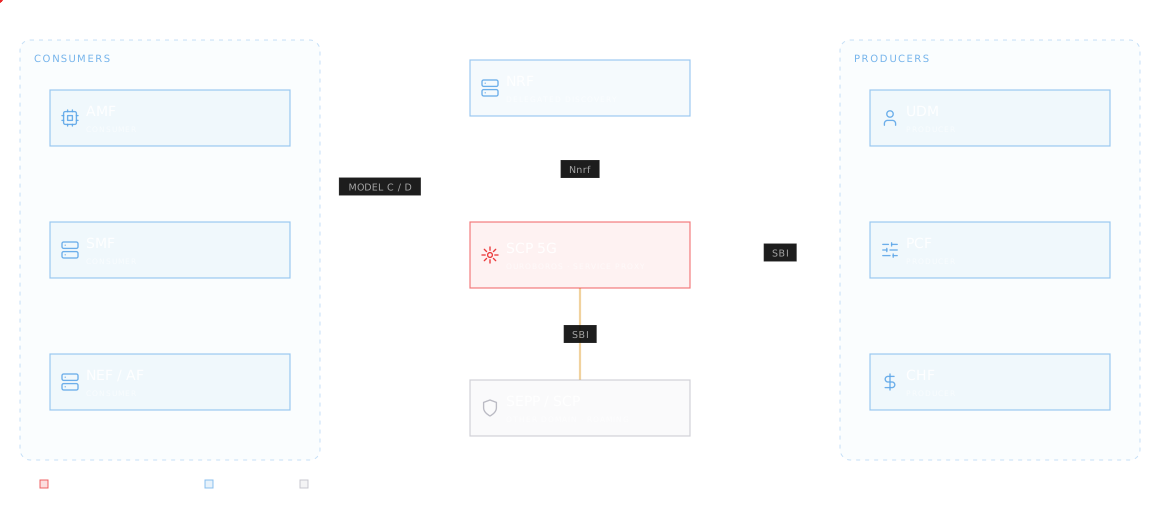
SCP 5G — indirect communication in the 5G core
Large cores, multi-site, slicing, multi-vendor, simpler functions — one routing layer.
Large and growing 5G cores
One routing layer replaces the full mesh of connections between network functions. Adding an instance does not touch its consumers.
Multi-site cores
SCP domains per site keep traffic local and fail over to another site when needed.
Slices with their own SCP
Each slice can have its own SCP domain, with its own producers and its own policies.
Multi-vendor cores
All SBI traffic goes through one point that balances, controls and traces it, whatever the vendor of each function.
Simpler network functions
With delegated discovery, functions no longer query the NRF or track instances themselves.

We've selected Ouroboros because it was the best company capable of fulfilling our need for a scalable and virtualised full MVNO platform. Moreover, the Ouroboros team is pragmatic, flexible and responsive.
Pascal Prot
CEO-CTO · Legos
Models C and D
Indirect communication with or without delegated discovery, chosen per consumer.
Load balancing
Requests are spread across producer instances according to their capacity and load.
Reselection and retry
A failed or overloaded instance is replaced by another one of the same set, without the consumer noticing.
Context binding
Following requests and notifications of a context reach the instance or set that holds it.
Overload control and priority
Overload information of the producers, message priority and rate limiting per consumer protect the core under load.
Tokens on behalf of consumers
The SCP obtains OAuth2 access tokens from the NRF for the requests it routes.
Observability
Counters per service, consumer and producer, SNMP traps, Prometheus metrics and SBI traces in one place.
IPv4, IPv6 and dual-stack
Every interface runs over IPv4, IPv6 or both. The element fits an IPv6 core or a mixed network without a separate configuration.
The SCP 5G comes from the same platform as the AMF, SMF, UDM, PCF, CHF and NRF it routes between, tested together in the Ouroboros TechLab. It also works with third-party network functions over the standard SBI.
Ouroboros has run signalling routers for years with its STP and DRA. The SCP 5G brings the same role to the service-based core: one routing layer, load sharing and failover, everything traced.

Tell us your sites, your slices and the network functions you run. We'll propose an SCP 5G topology to match, on OPEX or CAPEX.
 Product datasheet
5G Standalone · 5G Standalone
Service Communication Proxy (SCP 5G)
In a large 5G core, every network function talks to dozens of others. The SCP 5G gives them one hop to every service, and takes routing, discovery and failover off their hands.
In production since 2004 · 148M+ subscribers · 99.999% availability
A full mesh does not scale with the core
With direct communication, every 5G network function discovers its peers through the NRF, opens its own connections, chooses an instance and handles retries when that instance fails. As the core grows — more instances, more sites, more slices — that logic is repeated in every function and the number of connections grows with the square of the network.
Operations follow the same path. Load balancing, overload reactions and traces are spread across all the functions, from several vendors, each with its own behaviour.
Send it to the SCP, it finds the service.
Indirect communication and delegated discovery
A consumer sends its request to the SCP. If it has already discovered the producer, the SCP forwards the request (model C). If it only gives the discovery criteria — the service, the slice, the subscriber — the SCP queries the NRF on its behalf, selects a producer instance and forwards the request (model D).
Load balancing and failover
The SCP spreads the requests across the instances of each producer, follows their load and overload information, and reselects another instance or retries when one fails. Contexts are bound to their instance or set, so that the following requests and the notifications reach the right one.
Domains and roaming
Several SCPs can share the core by site or by slice and route between their domains. Traffic toward roaming partners leaves through the SEPP.
SCP 5G — indirect communication in the 5G core
How operators use it.
Large cores, multi-site, slicing, multi-vendor, simpler functions — one routing layer.
Large and growing 5G cores
One routing layer replaces the full mesh of connections between network functions. Adding an instance does not touch its consumers.
Multi-site cores
SCP domains per site keep traffic local and fail over to another site when needed.
Slices with their own SCP
Each slice can have its own SCP domain, with its own producers and its own policies.
Multi-vendor cores
All SBI traffic goes through one point that balances, controls and traces it, whatever the vendor of each function.
Simpler network functions
With delegated discovery, functions no longer query the NRF or track instances themselves.
Specifications.
Inside the platform.
Models C and D
Indirect communication with or without delegated discovery, chosen per consumer.
Load balancing
Requests are spread across producer instances according to their capacity and load.
Reselection and retry
A failed or overloaded instance is replaced by another one of the same set, without the consumer noticing.
Context binding
Following requests and notifications of a context reach the instance or set that holds it.
Overload control and priority
Overload information of the producers, message priority and rate limiting per consumer protect the core under load.
Tokens on behalf of consumers
The SCP obtains OAuth2 access tokens from the NRF for the requests it routes.
Observability
Counters per service, consumer and producer, SNMP traps, Prometheus metrics and SBI traces in one place.
IPv4, IPv6 and dual-stack
Every interface runs over IPv4, IPv6 or both. The element fits an IPv6 core or a mixed network without a separate configuration.
The SCP 5G comes from the same platform as the AMF, SMF, UDM, PCF, CHF and NRF it routes between, tested together in the Ouroboros TechLab. It also works with third-party network functions over the standard SBI.
Ouroboros has run signalling routers for years with its STP and DRA. The SCP 5G brings the same role to the service-based core: one routing layer, load sharing and failover, everything traced.
Network Repository Function (NRF)
The SCP discovers producers in the NRF on behalf of the consumers.
Security Edge Protection Proxy (SEPP)
Traffic toward roaming partners leaves the core through the SEPP.
Diameter Routing Agent (DRA)
The routing layer of the 4G Diameter signalling, next to the SCP 5G.
Next step
Is your 5G core growing?
Tell us your sites, your slices and the network functions you run. We'll propose an SCP 5G topology to match, on OPEX or CAPEX.