Printed scratch cards must be produced, insured, stored, transported, and protected from theft before a single unit of credit is sold. The Ouroboros VOMS turns your distribution network into a fully electronic one: wholesalers and retailers sell credit and e-vouchers from their own mobile.
In prepaid markets, recharge is the revenue. Yet most of it still depends on physical cards. Every card is printed, shipped, stored, insured, and handed from wholesaler to retailer before it reaches the subscriber. Stock runs out at the wrong place. Retailers carry valuable stock and become targets for theft. Only the face values that were printed can be sold.
The operator also loses visibility. Once cards leave the warehouse, nobody knows which reseller sold what, when, or to whom, until the voucher is finally scratched.

Resellers hold electronic stock
The operator declares wholesalers, distributors and retailers, and allocates them either an amount of credit (voucherless) or a quantity of electronic vouchers (e-vouchers). Each reseller sells to subscribers or to other resellers below them.
Distribution and retail networks
In the distribution network (reseller to reseller), wholesalers, distributors and retailers exchange credit or e-vouchers against money. In the retail network (reseller to subscriber), the reseller transfers credit or an e-voucher to the subscriber's account on the billing platform. A single USSD code or SMS number is enough; transfers are secured with non-trivial service codes.
Secured transaction and credit delivery
When a reseller sells a recharge, the platform checks the reseller's stock, opens a transaction, and debits the reseller. After a configurable delay during which the reseller can correct a mistake, the credit is sent to the billing platform over UCIP, Diameter, SOAP or a proprietary interface. The subscriber receives the amount plus any bonus attached to the voucher type or credit tier, and both parties receive a confirmation SMS with the transaction number and the new balance.
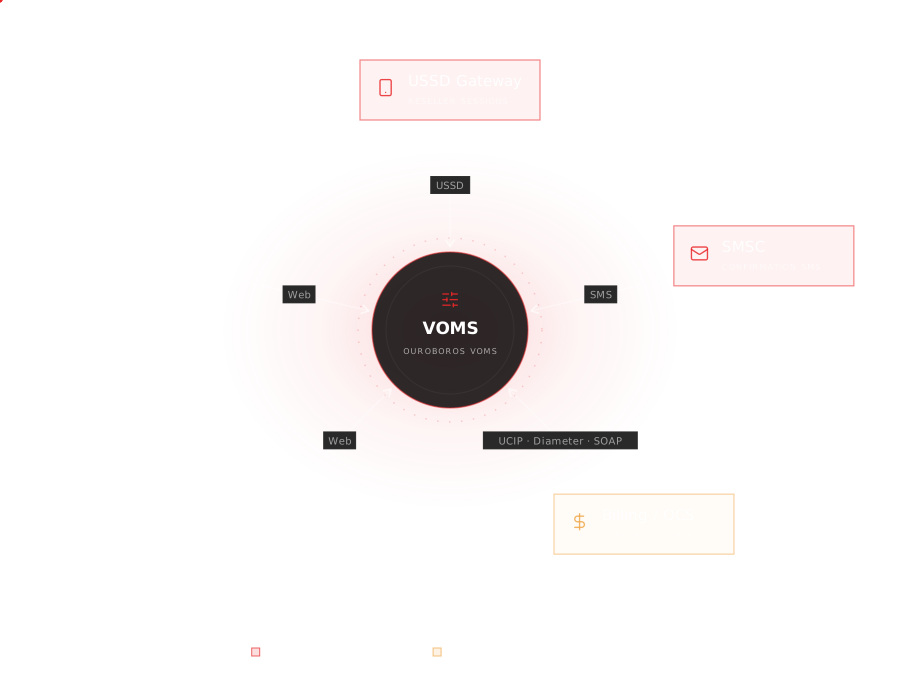
VOMS — electronic distribution of prepaid credit
Scratch-card replacement, free face values, bonus plans, reseller hierarchy, secured field sales — one electronic distribution network.
Replace scratch cards
A prepaid operator moves its distribution to e-vouchers and voucherless credit. Printing, transport and storage costs disappear; resellers restock instantly from their mobile.
Any face value
In credit mode, a reseller sells exactly the amount the subscriber asks for. No unsold denominations, no lost sale because a card value is out of stock.
Bonus and promotional plans
E-voucher characteristics and bonus plans are fully configurable: extra minutes, SMS, or a percentage bonus per voucher type or credit tier.
Hierarchical reseller network
Wholesalers create and manage their own retailers over the Web, USSD or SMS, set the number of lines per reseller, and decide who may redistribute.
Secured field sales
Each reseller line is protected by its own access code. Lines not declared for a reseller are refused, and three wrong codes block the line.

We've selected Ouroboros because it was the best company capable of fulfilling our need for a scalable and virtualised full MVNO platform. Moreover, the Ouroboros team is pragmatic, flexible and responsive.
Pascal Prot
CEO-CTO · Legos
Five rights levels
Administrators manage the database; operators credit accounts, create wholesalers and retailers, and resolve disputes; wholesalers transfer credit and manage their subordinates; retailers transfer credit; subscribers receive it. Each actor sees exactly what they need, from the operator's intranet down to the street retailer.
E-vouchers and voucherless credit
Resellers hold stock as electronic vouchers or as a credit amount. Operators choose per channel between fixed denominations and free amounts.
Correction window
The reseller can correct a transaction during a configurable delay before the credit is committed. Typing mistakes on a subscriber number no longer become customer service disputes.
Reseller self-care over USSD
Resellers check their balance, block a stolen line, create sub-resellers, or change their access code from any handset. The distribution network manages itself without calls to the operator.
Independent from billing
The resale system runs apart from the billing platform and only sends the final credit. Distribution traffic does not load the billing system.
Any billing platform
Credit is delivered over UCIP, Diameter, SOAP, or proprietary interfaces. The VOMS works with the Ouroboros OCS or with an existing third-party IN.
IPv4, IPv6 and dual-stack
Every interface runs over IPv4, IPv6 or both. The element fits an IPv6 core or a mixed network without a separate configuration.
Electronic distribution brings economic, logistical and environmental gains: fewer printed vouchers, no insurance or security for stock in transit, immediate restocking, and safer resellers who no longer carry valuable cards. Any recharge value can be sold.
The Ouroboros VOMS runs on the same AMTP platform as the USSD Gateway, SMSC and OCS, so the full recharge chain, from the reseller's USSD request to the confirmation SMS and the balance update, comes from one vendor.
OPEX rental is available, so operators can start electronic distribution without a capital programme.

Tell us how your prepaid credit is distributed today, how many resellers you work with, and which billing platform you run. We'll propose an electronic distribution plan, on OPEX or CAPEX.
 Product datasheet
2G to 5G · Charging & Billing
Voucher Management System (VOMS)
Printed scratch cards must be produced, insured, stored, transported, and protected from theft before a single unit of credit is sold. The Ouroboros VOMS turns your distribution network into a fully electronic one: wholesalers and retailers sell credit and e-vouchers from their own mobile.
In production since 2004 · 148M+ subscribers · 99.999% availability
The hidden cost of physical vouchers
In prepaid markets, recharge is the revenue. Yet most of it still depends on physical cards. Every card is printed, shipped, stored, insured, and handed from wholesaler to retailer before it reaches the subscriber. Stock runs out at the wrong place. Retailers carry valuable stock and become targets for theft. Only the face values that were printed can be sold.
The operator also loses visibility. Once cards leave the warehouse, nobody knows which reseller sold what, when, or to whom, until the voucher is finally scratched.
A resale network without any physical medium.
Resellers hold electronic stock
The operator declares wholesalers, distributors and retailers, and allocates them either an amount of credit (voucherless) or a quantity of electronic vouchers (e-vouchers). Each reseller sells to subscribers or to other resellers below them.
Distribution and retail networks
In the distribution network (reseller to reseller), wholesalers, distributors and retailers exchange credit or e-vouchers against money. In the retail network (reseller to subscriber), the reseller transfers credit or an e-voucher to the subscriber's account on the billing platform. A single USSD code or SMS number is enough; transfers are secured with non-trivial service codes.
Secured transaction and credit delivery
When a reseller sells a recharge, the platform checks the reseller's stock, opens a transaction, and debits the reseller. After a configurable delay during which the reseller can correct a mistake, the credit is sent to the billing platform over UCIP, Diameter, SOAP or a proprietary interface. The subscriber receives the amount plus any bonus attached to the voucher type or credit tier, and both parties receive a confirmation SMS with the transaction number and the new balance.
VOMS — electronic distribution of prepaid credit
How operators use it.
Scratch-card replacement, free face values, bonus plans, reseller hierarchy, secured field sales — one electronic distribution network.
Replace scratch cards
A prepaid operator moves its distribution to e-vouchers and voucherless credit. Printing, transport and storage costs disappear; resellers restock instantly from their mobile.
Any face value
In credit mode, a reseller sells exactly the amount the subscriber asks for. No unsold denominations, no lost sale because a card value is out of stock.
Bonus and promotional plans
E-voucher characteristics and bonus plans are fully configurable: extra minutes, SMS, or a percentage bonus per voucher type or credit tier.
Hierarchical reseller network
Wholesalers create and manage their own retailers over the Web, USSD or SMS, set the number of lines per reseller, and decide who may redistribute.
Secured field sales
Each reseller line is protected by its own access code. Lines not declared for a reseller are refused, and three wrong codes block the line.
Specifications.
Inside the platform.
Five rights levels
Administrators manage the database; operators credit accounts, create wholesalers and retailers, and resolve disputes; wholesalers transfer credit and manage their subordinates; retailers transfer credit; subscribers receive it. Each actor sees exactly what they need, from the operator's intranet down to the street retailer.
E-vouchers and voucherless credit
Resellers hold stock as electronic vouchers or as a credit amount. Operators choose per channel between fixed denominations and free amounts.
Correction window
The reseller can correct a transaction during a configurable delay before the credit is committed. Typing mistakes on a subscriber number no longer become customer service disputes.
Reseller self-care over USSD
Resellers check their balance, block a stolen line, create sub-resellers, or change their access code from any handset. The distribution network manages itself without calls to the operator.
Independent from billing
The resale system runs apart from the billing platform and only sends the final credit. Distribution traffic does not load the billing system.
Any billing platform
Credit is delivered over UCIP, Diameter, SOAP, or proprietary interfaces. The VOMS works with the Ouroboros OCS or with an existing third-party IN.
IPv4, IPv6 and dual-stack
Every interface runs over IPv4, IPv6 or both. The element fits an IPv6 core or a mixed network without a separate configuration.
Electronic distribution brings economic, logistical and environmental gains: fewer printed vouchers, no insurance or security for stock in transit, immediate restocking, and safer resellers who no longer carry valuable cards. Any recharge value can be sold.
The Ouroboros VOMS runs on the same AMTP platform as the USSD Gateway, SMSC and OCS, so the full recharge chain, from the reseller's USSD request to the confirmation SMS and the balance update, comes from one vendor.
OPEX rental is available, so operators can start electronic distribution without a capital programme.
USSD TopUp
Subscriber-side services: credit transfer, credit reserve, balance and voucher recharge over USSD or SMS.
USSD Gateway
Carries the reseller and subscriber USSD sessions to the VOMS.
Online Charging System (OCS)
Receives the credit sold by resellers and updates the subscriber balance.
Messaging Center
Delivers the confirmation SMS to subscribers and resellers.
Next step
How much does your scratch card logistics really cost?
Tell us how your prepaid credit is distributed today, how many resellers you work with, and which billing platform you run. We'll propose an electronic distribution plan, on OPEX or CAPEX.