- 01MSC / VLRMSC/VLR
- 02Gateway Mobile Switching CenterGMSC
- 03Gateway Mobile Location CentreGMLC
- 04Home Location RegisterHLR
- 05Messaging CenterSMSC
- 06Signaling Transfer PointSTP
- 07GGSN / SGSNGGSN
- 08S4-SGSNSGSN
- 09Equipment Identity RegisterEIR
- 10Service Control PointSCP
- 11USSD GatewayUSSD
- 12Cell Broadcast CentreCBC
Emergency services, fleet tracking, lawful requests and location-based offers all ask the same question: where is this subscriber now? The GMLC answers it for your applications, from the network itself, without an app on the handset.
The serving MSC or SGSN knows the cell of every attached subscriber. That information is valuable to emergency services, to enterprise fleet and asset tracking, and to location-based services. But it sits behind SS7 signalling that an application developer cannot reach.
Handset-based location needs an app, a data session and the user's consent on the device, and it fails on basic phones and IoT modules. A network-based gateway works for every subscriber, on every handset, under the control of the operator.

The application asks
A location-based application sends a request for a subscriber (MSISDN or IMSI) to the GMLC over its HTTP API. The GMLC checks the request and keeps the session open while it locates the subscriber.
The subscriber database names the serving node
The GMLC asks where the subscriber is registered: the HLR over MAP (Lh, Send Routing Info for LCS) in 2G and 3G, the HSS over Diameter (SLh) in 4G, the UDM over the service based interface (NL6) in 5G. The answer is the MSC/VLR, SGSN, MME or AMF currently serving the subscriber.
The serving node gives the position
The GMLC requests the location from that node: Provide Subscriber Location over MAP (Lg) toward the MSC/VLR or SGSN, Provide Location over Diameter (SLg) toward the MME, Namf_Location (NL2) toward the AMF, which hands the positioning to the LMF for a precise 5G position. The position comes back to the application in the HTTP response.
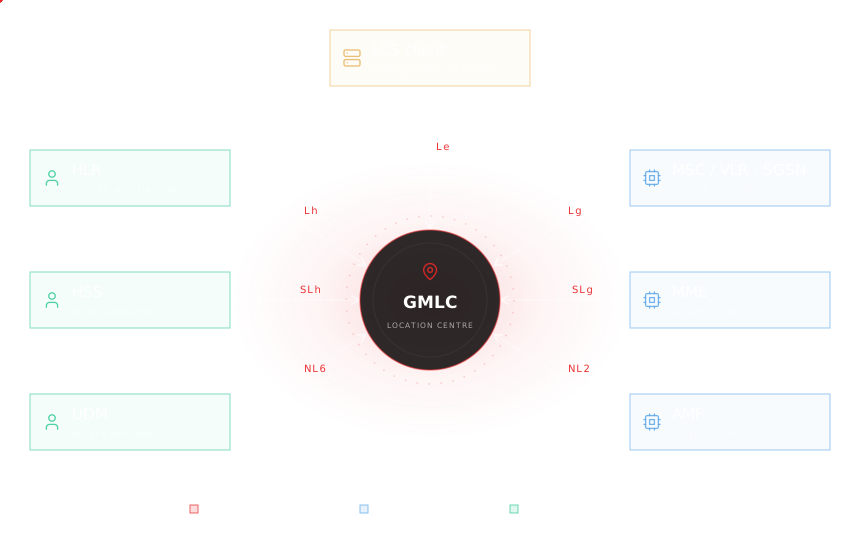
GMLC — network location for applications, from 2G to 5G
Emergency location, fleet tracking, location-based services, operator tools — one location gateway.
Emergency services
Public safety answering points obtain the location of a caller from the network, whatever the handset.
Fleet and asset tracking
Enterprises locate their vehicles, workers or IoT modules through an operator API, with no tracking app on the device.
Location-based services
Operators and partners offer location-aware content, offers and alerts based on the serving area of the subscriber.
Operator tools
Customer care, fraud and network teams check where a subscriber is attached when handling a complaint or an incident.

We've selected Ouroboros because it was the best company capable of fulfilling our need for a scalable and virtualised full MVNO platform. Moreover, the Ouroboros team is pragmatic, flexible and responsive.
Pascal Prot
CEO-CTO · Legos
Network-based location
The position comes from the serving MSC, SGSN, MME or AMF, so it works for every subscriber, including basic phones and IoT modules.
Simple HTTP API
Applications use an HTTP request and response instead of SS7 signalling. Integration takes days, not a telecom project.
Every generation, standard interfaces
MAP Lh and Lg in 2G and 3G, Diameter SLh and SLg in 4G, NL6 and NL2 on the service based interface in 5G. The GMLC works with the subscriber databases and serving nodes already in the network.
One gateway for the whole network
Subscribers are located wherever they are attached: MSC/VLR, SGSN, MME or AMF. Applications use one API whatever the radio generation.
Part of the Ouroboros core
The GMLC works natively with the Ouroboros HLR, HSS, UDM, MSC/VLR, SGSN, MME and AMF, and with third-party elements through the same standard interfaces.
IPv4, IPv6 and dual-stack
Every interface runs over IPv4, IPv6 or both. The element fits an IPv6 core or a mixed network without a separate configuration.
A location gateway is a small element with a big integration cost when it comes from a vendor that only sells large location platforms. The Ouroboros GMLC is sized for operators who want to expose network location to their own applications and partners through a simple API, on the same platform as their HLR and switching core.
It runs on bare metal, VMware, KVM, Docker or Kubernetes, with the same carrier-grade redundancy as the rest of the platform.

Tell us your use case, your HLR and serving nodes, and the request volume you expect. We'll propose a GMLC configuration on OPEX or CAPEX.
 Product datasheet
2G to 5G · 2G/3G Core · 4G/LTE · 5G Standalone
Gateway Mobile Location Centre (GMLC)
Emergency services, fleet tracking, lawful requests and location-based offers all ask the same question: where is this subscriber now? The GMLC answers it for your applications, from the network itself, without an app on the handset.
In production since 2011 · 99.999% availability
The network knows where the subscriber is. Your applications do not.
The serving MSC or SGSN knows the cell of every attached subscriber. That information is valuable to emergency services, to enterprise fleet and asset tracking, and to location-based services. But it sits behind SS7 signalling that an application developer cannot reach.
Handset-based location needs an app, a data session and the user's consent on the device, and it fails on basic phones and IoT modules. A network-based gateway works for every subscriber, on every handset, under the control of the operator.
From an HTTP request to the position of the subscriber.
The application asks
A location-based application sends a request for a subscriber (MSISDN or IMSI) to the GMLC over its HTTP API. The GMLC checks the request and keeps the session open while it locates the subscriber.
The subscriber database names the serving node
The GMLC asks where the subscriber is registered: the HLR over MAP (Lh, Send Routing Info for LCS) in 2G and 3G, the HSS over Diameter (SLh) in 4G, the UDM over the service based interface (NL6) in 5G. The answer is the MSC/VLR, SGSN, MME or AMF currently serving the subscriber.
The serving node gives the position
The GMLC requests the location from that node: Provide Subscriber Location over MAP (Lg) toward the MSC/VLR or SGSN, Provide Location over Diameter (SLg) toward the MME, Namf_Location (NL2) toward the AMF, which hands the positioning to the LMF for a precise 5G position. The position comes back to the application in the HTTP response.
GMLC — network location for applications, from 2G to 5G
How operators use it.
Emergency location, fleet tracking, location-based services, operator tools — one location gateway.
Emergency services
Public safety answering points obtain the location of a caller from the network, whatever the handset.
Fleet and asset tracking
Enterprises locate their vehicles, workers or IoT modules through an operator API, with no tracking app on the device.
Location-based services
Operators and partners offer location-aware content, offers and alerts based on the serving area of the subscriber.
Operator tools
Customer care, fraud and network teams check where a subscriber is attached when handling a complaint or an incident.
Specifications.
Inside the platform.
Network-based location
The position comes from the serving MSC, SGSN, MME or AMF, so it works for every subscriber, including basic phones and IoT modules.
Simple HTTP API
Applications use an HTTP request and response instead of SS7 signalling. Integration takes days, not a telecom project.
Every generation, standard interfaces
MAP Lh and Lg in 2G and 3G, Diameter SLh and SLg in 4G, NL6 and NL2 on the service based interface in 5G. The GMLC works with the subscriber databases and serving nodes already in the network.
One gateway for the whole network
Subscribers are located wherever they are attached: MSC/VLR, SGSN, MME or AMF. Applications use one API whatever the radio generation.
Part of the Ouroboros core
The GMLC works natively with the Ouroboros HLR, HSS, UDM, MSC/VLR, SGSN, MME and AMF, and with third-party elements through the same standard interfaces.
IPv4, IPv6 and dual-stack
Every interface runs over IPv4, IPv6 or both. The element fits an IPv6 core or a mixed network without a separate configuration.
A location gateway is a small element with a big integration cost when it comes from a vendor that only sells large location platforms. The Ouroboros GMLC is sized for operators who want to expose network location to their own applications and partners through a simple API, on the same platform as their HLR and switching core.
It runs on bare metal, VMware, KVM, Docker or Kubernetes, with the same carrier-grade redundancy as the rest of the platform.
Home Location Register (HLR)
Gives the GMLC the serving node of the subscriber over Lh.
Home Subscriber Server (HSS)
Gives the serving MME over SLh.
Unified Data Management (UDM)
Gives the serving AMF over NL6.
vEPC
The MME returns the location of the 4G subscribers over SLg.
AMF
Returns the location of the 5G subscribers over NL2.
Location Management Function (LMF)
Computes the precise position of the 5G devices behind the AMF.
MSC / VLR
Returns the location of the subscribers in the circuit domain over Lg.
Serving GPRS Support Node (S4-SGSN)
Returns the location of the subscribers in the packet domain over Lg.
Signaling Transfer Point (STP)
Routes the MAP signalling of the GMLC.
Next step
Which of your applications need to know where the subscriber is?
Tell us your use case, your HLR and serving nodes, and the request volume you expect. We'll propose a GMLC configuration on OPEX or CAPEX.