- 01Access and Mobility Management FunctionAMF
- 02Unified Data ManagementUDM
- 03Policy Control FunctionPCF
- 04Network Repository FunctionNRF
- 05Non-3GPP Interworking FunctionN3IWF
- 06Security Edge Protection ProxySEPP
- 07Network Slice Selection FunctionNSSF
- 08Service Communication ProxySCP
- 09Application FunctionAF
- 10Location Management FunctionLMF
- 11Cell Broadcast CentreCBCF
- 12Gateway Mobile Location CentreGMLC
- 13Session Management FunctionSMF
- 14User Plane FunctionUPF
- 15SMS FunctionSMSF
- 16Equipment Identity RegisterEIR
In a 5G core, network functions find each other at runtime. The NRF is the directory they ask, and the authority that decides who may call whom.
In 4G, each node is configured with the addresses of its peers. A 5G core is built differently: AMF, SMF, UDM, PCF, CHF and SMSF expose services over HTTP/2, scale out and in, and move between sites. Hard-coding every peer in every function turns each scaling event into a configuration change across the network.
Security follows the same pattern. Without a central authority, every function has to decide on its own whether a caller is allowed to use its services. Mistakes are hard to spot and harder to audit.

Registration and heartbeats
Every network function of the 5G core registers its profile with the NRF when it starts: its type, its instance identifier, the services it offers, the slices, PLMNs and DNNs it serves. It then sends regular heartbeats. A function that stops sending them is suspended, then removed, so the directory always reflects what is actually running.
Discovery and status notifications
When an AMF needs an SMF for a given slice and DNN, or a UDM for a given SUPI range, it asks the NRF. Discovery filters by NF type, instance, service name, S-NSSAI, PLMN, GUAMI, DNN, SUPI and routing indicator. Functions can also subscribe to status changes and are notified when a peer registers, leaves or changes its profile.
OAuth2 access tokens
The NRF also issues OAuth2 access tokens. A function obtains a token for the service it wants to call, and the callee checks it. Tokens are signed and their lifetime is set by configuration, as are heartbeat periods and the validity of discoveries and subscriptions.
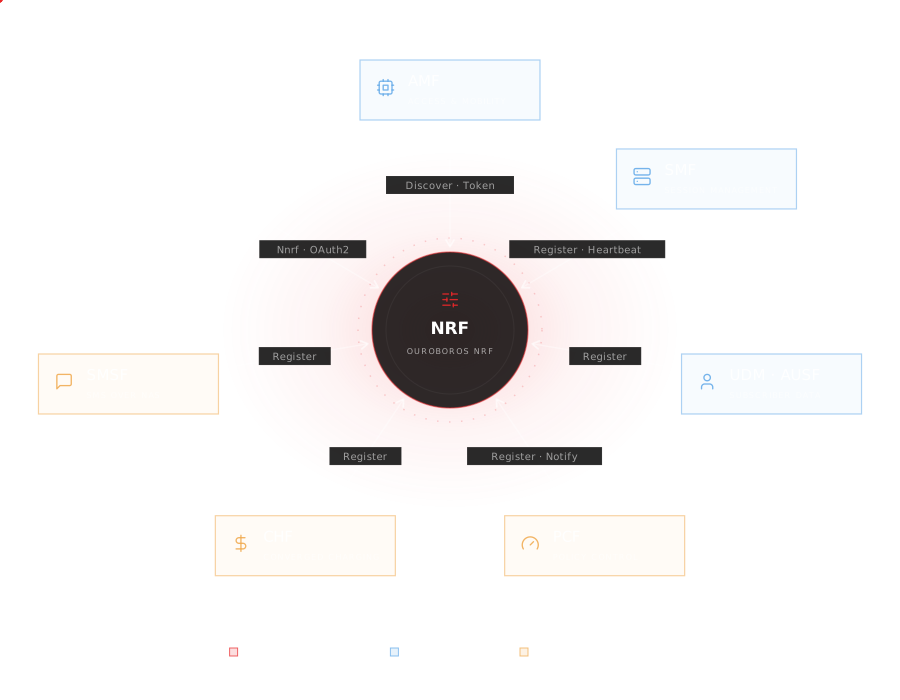
NRF — registry and access tokens of the 5G core
Ouroboros 5G core, cloud-native scaling, slicing, SBI security, multi-vendor cores — one directory.
Ouroboros 5G SA core
The Ouroboros AMF, SMF, UDM, PCF, CHF and SMSF register their profiles in the NRF and discover their peers through it. Adding an instance is a deployment, not a reconfiguration of every neighbour.
Elastic and cloud-native deployments
On Kubernetes or public cloud, instances come and go. Heartbeat supervision keeps the directory accurate and status notifications tell consumers immediately.
Network slicing
Profiles carry the slices and DNNs each function serves. Discovery by S-NSSAI and DNN routes each session to a function dedicated to its slice.
Securing the Service Based Interface
Access tokens restrict each service to the network functions entitled to use it, on top of mutual TLS authentication.
Multi-vendor 5G core
Third-party network functions use the same standard registration, discovery and token services as the Ouroboros functions.

We've selected Ouroboros because it was the best company capable of fulfilling our need for a scalable and virtualised full MVNO platform. Moreover, the Ouroboros team is pragmatic, flexible and responsive.
Pascal Prot
CEO-CTO · Legos
Live registry of network functions
Profiles, services and heartbeats of every 5G function in one place. The operator sees at a glance which instances are running and what they serve.
Automatic clean-up
Functions that miss their heartbeats are suspended, then removed. Consumers are never sent to an instance that is no longer there.
Rich discovery
Queries by slice, DNN, PLMN, GUAMI, SUPI and routing indicator. Each request reaches the right instance for the subscriber and the slice, without static routing tables.
Status notifications
Consumers subscribe to the functions they depend on. Failover starts as soon as a peer leaves, not at the next timeout.
OAuth2 access tokens
Signed tokens issued per service and checked by the Ouroboros network functions. Access control on the SBI is central, consistent and auditable.
Configurable lifetimes
Heartbeat, discovery validity, subscription validity and token lifetime are set by configuration. The balance between signalling load and reaction time is the operator's choice.
Extensive logging
Every registration, discovery and token request is traced. Integration issues in a multi-vendor core are diagnosed quickly.
IPv4, IPv6 and dual-stack
Every interface runs over IPv4, IPv6 or both. The element fits an IPv6 core or a mixed network without a separate configuration.
The NRF is small, but every 5G function depends on it. The Ouroboros NRF comes from the same platform as the AMF, SMF, UDM, PCF, CHF and SMSF it serves, tested together in the Ouroboros TechLab. The directory, the discovery rules and the token checks are already aligned with the functions that use them.
It runs on the same infrastructure options as the rest of the core: bare metal, VMware, KVM, Docker, Kubernetes or public cloud, with active-active and geographical redundancy.
OPEX rental is available.

Tell us your 5G SA architecture, your slices and your deployment target. We'll propose an NRF configuration and redundancy model to match, on OPEX or CAPEX.
 Product datasheet
5G Standalone · 5G Standalone
Network Repository Function (NRF)
In a 5G core, network functions find each other at runtime. The NRF is the directory they ask, and the authority that decides who may call whom.
In production since 2004 · 148M+ subscribers · 99.999% availability
Static peer tables do not scale with a service-based core
In 4G, each node is configured with the addresses of its peers. A 5G core is built differently: AMF, SMF, UDM, PCF, CHF and SMSF expose services over HTTP/2, scale out and in, and move between sites. Hard-coding every peer in every function turns each scaling event into a configuration change across the network.
Security follows the same pattern. Without a central authority, every function has to decide on its own whether a caller is allowed to use its services. Mistakes are hard to spot and harder to audit.
Register, discover, authorise.
Registration and heartbeats
Every network function of the 5G core registers its profile with the NRF when it starts: its type, its instance identifier, the services it offers, the slices, PLMNs and DNNs it serves. It then sends regular heartbeats. A function that stops sending them is suspended, then removed, so the directory always reflects what is actually running.
Discovery and status notifications
When an AMF needs an SMF for a given slice and DNN, or a UDM for a given SUPI range, it asks the NRF. Discovery filters by NF type, instance, service name, S-NSSAI, PLMN, GUAMI, DNN, SUPI and routing indicator. Functions can also subscribe to status changes and are notified when a peer registers, leaves or changes its profile.
OAuth2 access tokens
The NRF also issues OAuth2 access tokens. A function obtains a token for the service it wants to call, and the callee checks it. Tokens are signed and their lifetime is set by configuration, as are heartbeat periods and the validity of discoveries and subscriptions.
NRF — registry and access tokens of the 5G core
How operators use it.
Ouroboros 5G core, cloud-native scaling, slicing, SBI security, multi-vendor cores — one directory.
Ouroboros 5G SA core
The Ouroboros AMF, SMF, UDM, PCF, CHF and SMSF register their profiles in the NRF and discover their peers through it. Adding an instance is a deployment, not a reconfiguration of every neighbour.
Elastic and cloud-native deployments
On Kubernetes or public cloud, instances come and go. Heartbeat supervision keeps the directory accurate and status notifications tell consumers immediately.
Network slicing
Profiles carry the slices and DNNs each function serves. Discovery by S-NSSAI and DNN routes each session to a function dedicated to its slice.
Securing the Service Based Interface
Access tokens restrict each service to the network functions entitled to use it, on top of mutual TLS authentication.
Multi-vendor 5G core
Third-party network functions use the same standard registration, discovery and token services as the Ouroboros functions.
Specifications.
Inside the platform.
Live registry of network functions
Profiles, services and heartbeats of every 5G function in one place. The operator sees at a glance which instances are running and what they serve.
Automatic clean-up
Functions that miss their heartbeats are suspended, then removed. Consumers are never sent to an instance that is no longer there.
Rich discovery
Queries by slice, DNN, PLMN, GUAMI, SUPI and routing indicator. Each request reaches the right instance for the subscriber and the slice, without static routing tables.
Status notifications
Consumers subscribe to the functions they depend on. Failover starts as soon as a peer leaves, not at the next timeout.
OAuth2 access tokens
Signed tokens issued per service and checked by the Ouroboros network functions. Access control on the SBI is central, consistent and auditable.
Configurable lifetimes
Heartbeat, discovery validity, subscription validity and token lifetime are set by configuration. The balance between signalling load and reaction time is the operator's choice.
Extensive logging
Every registration, discovery and token request is traced. Integration issues in a multi-vendor core are diagnosed quickly.
IPv4, IPv6 and dual-stack
Every interface runs over IPv4, IPv6 or both. The element fits an IPv6 core or a mixed network without a separate configuration.
The NRF is small, but every 5G function depends on it. The Ouroboros NRF comes from the same platform as the AMF, SMF, UDM, PCF, CHF and SMSF it serves, tested together in the Ouroboros TechLab. The directory, the discovery rules and the token checks are already aligned with the functions that use them.
It runs on the same infrastructure options as the rest of the core: bare metal, VMware, KVM, Docker, Kubernetes or public cloud, with active-active and geographical redundancy.
OPEX rental is available.
Access and Mobility Management Function (AMF)
The AMF discovers the SMF, UDM, AUSF, PCF and SMSF of each subscriber through the NRF.
Session Management Function (SMF)
The SMF registers the slices and DNNs it serves, so the AMF selects it per session.
Unified Data Management (UDM)
The UDM registers its services and checks the access tokens issued by the NRF.
Next step
How many network functions will your 5G core run?
Tell us your 5G SA architecture, your slices and your deployment target. We'll propose an NRF configuration and redundancy model to match, on OPEX or CAPEX.