- 01MSC / VLRMSC/VLR
- 02Gateway Mobile Switching CenterGMSC
- 03Gateway Mobile Location CentreGMLC
- 04Home Location RegisterHLR
- 05Messaging CenterSMSC
- 06Signaling Transfer PointSTP
- 07GGSN / SGSNGGSN
- 08S4-SGSNSGSN
- 09Equipment Identity RegisterEIR
- 10Service Control PointSCP
- 11USSD GatewayUSSD
- 12Cell Broadcast CentreCBC
When a flood, a fire or an industrial accident threatens a town, the authorities need to reach every phone in the area within minutes, without a subscriber list and without saturating the SMS core. Cell broadcast does exactly that. The Ouroboros CBC sends the message once to the radio network, and every handset in the selected cells receives it, on 2G, 3G, 4G and 5G.
An SMS campaign needs a list of numbers, and it queues behind every other message on the SMS core. In an emergency, the people in danger include roamers and visitors whose numbers nobody has, and the minutes lost while the SMSC works through millions of messages are the minutes that matter.
Cell broadcast solves both problems: one message per cell, received by every handset camped on it. But the radio network is rarely uniform. BSCs, RNCs, MMEs and AMFs from different generations and manufacturers each expect their own protocol, and a warning that reaches only one layer misses everyone camped on the others.

Define the message and the zone
Authorities and the operator define the warning in the Cell Broadcast Entity (CBE), a graphical console. The target zone is drawn on a map from cells, named groups such as a town or a district, or several selectable zones. Each message carries its text or binary content, its start time, its end time, its repetition interval, the broadcast channel and the emergency indication that separates a warning from a normal broadcast.
The CBC resolves the cells
The CBC holds the position, shape and radius of every cell and groups them by BSC, RNC, MME or AMF. It determines the set of cells for each message, allocates the serial numbers that tell handsets which broadcasts they have already shown, and indicates the geographical scope of the message.
Broadcast on 2G, 3G, 4G and 5G
The message goes to the BSCs over CBSP, to the RNCs over SABP on the Iu-BC interface, and to the MMEs over SBc-AP, which relay it to their eNodeBs. In the 5G core, the CBC acts as Cell Broadcast Centre Function (CBCF): it sends the warning to the AMFs over N50, a service-based interface on HTTP/2, and the AMFs relay it to their gNodeBs. Messages held by the radio controllers can be replaced, modified or deleted at any time, and the CBC queries their status and load.
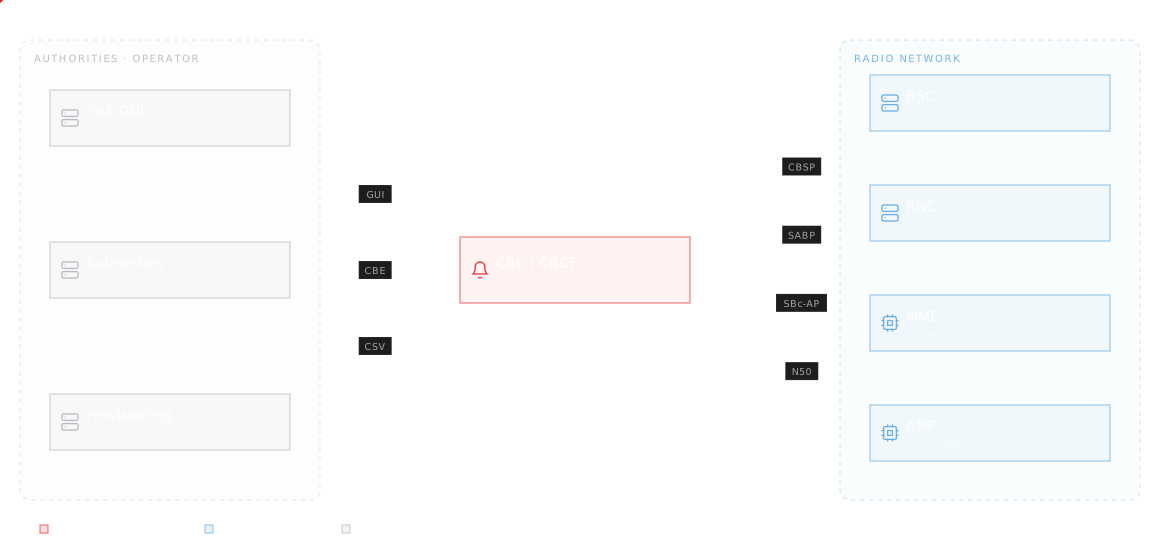
CBC / CBCF — public warning to every cell of a zone, on 2G, 3G, 4G and 5G
Public warning, emergency alerts, area information, network announcements — one broadcast centre.
Public warning of the population
Natural disasters, industrial accidents and public safety threats are announced to every handset in the affected area, including roamers and visitors, without any subscriber list.
Emergency messages on every generation
The same warning reaches 2G, 3G, 4G and 5G cells at once, with the emergency indication that handsets present differently from a normal broadcast.
Information by area
A town, a district, an event site or a border zone receives its own message, defined on the map and repeated for as long as it is needed.
Network and commercial information
Cell or area names, service announcements and local offers are broadcast to the subscribers present in a zone, without loading the SMS core.

We've selected Ouroboros because it was the best company capable of fulfilling our need for a scalable and virtualised full MVNO platform. Moreover, the Ouroboros team is pragmatic, flexible and responsive.
Pascal Prot
CEO-CTO · Legos
One centre for 2G, 3G, 4G and 5G
CBSP, SABP, SBc-AP and N50 from a single CBC, with the manufacturer variants of the BSCs, RNCs and MMEs. No separate broadcast platform per generation.
Map-driven zone selection
Cells carry their position, shape and radius. Operators select the target on a map, by named group or by several zones at once.
No limit on cells or groups
The cell and group tables have no fixed ceiling. A national network and a single campus run on the same product.
Full message life cycle
Single or multiple messages, in text or binary, are scheduled with a start, an end and a repetition interval, then replaced, modified or deleted on the radio controllers when the situation changes.
Status and load of the radio network
The CBC queries the messages in emission and the load of the radio controllers, so the operator knows what is being broadcast and where.
Simple provisioning
Cells, BSCs, RNCs, MMEs and AMFs are loaded from CSV files exported from the radio planning tools.
IPv4, IPv6 and dual-stack
Every interface runs over IPv4, IPv6 or both. The element fits an IPv6 core or a mixed network without a separate configuration.
A public warning system is only as good as its weakest radio layer. The Ouroboros CBC covers 2G, 3G, 4G and 5G from one console, so a warning issued once reaches every handset in the zone, whatever network it is camped on.
The product is sized for national use: two 1U servers broadcast one message per minute to 300 000 cells, and two or three instances can run in parallel for the service. It runs on bare metal, VMware, KVM, Docker or Kubernetes, alongside the rest of the Ouroboros core or in front of any vendor's radio network.

Tell us your radio vendors, the number of cells, and the authorities you work with. We'll show how the CBC covers 2G, 3G, 4G and 5G from one console.
 Product datasheet
2G / 3G / 4G / 5G · 4G/LTE
Cell Broadcast Centre (CBC / CBCF)
When a flood, a fire or an industrial accident threatens a town, the authorities need to reach every phone in the area within minutes, without a subscriber list and without saturating the SMS core. Cell broadcast does exactly that. The Ouroboros CBC sends the message once to the radio network, and every handset in the selected cells receives it, on 2G, 3G, 4G and 5G.
In production since 2004 · 148M+ subscribers · 99.999% availability
Reaching everyone in a zone, now
An SMS campaign needs a list of numbers, and it queues behind every other message on the SMS core. In an emergency, the people in danger include roamers and visitors whose numbers nobody has, and the minutes lost while the SMSC works through millions of messages are the minutes that matter.
Cell broadcast solves both problems: one message per cell, received by every handset camped on it. But the radio network is rarely uniform. BSCs, RNCs, MMEs and AMFs from different generations and manufacturers each expect their own protocol, and a warning that reaches only one layer misses everyone camped on the others.
One message, every cell, every generation.
Define the message and the zone
Authorities and the operator define the warning in the Cell Broadcast Entity (CBE), a graphical console. The target zone is drawn on a map from cells, named groups such as a town or a district, or several selectable zones. Each message carries its text or binary content, its start time, its end time, its repetition interval, the broadcast channel and the emergency indication that separates a warning from a normal broadcast.
The CBC resolves the cells
The CBC holds the position, shape and radius of every cell and groups them by BSC, RNC, MME or AMF. It determines the set of cells for each message, allocates the serial numbers that tell handsets which broadcasts they have already shown, and indicates the geographical scope of the message.
Broadcast on 2G, 3G, 4G and 5G
The message goes to the BSCs over CBSP, to the RNCs over SABP on the Iu-BC interface, and to the MMEs over SBc-AP, which relay it to their eNodeBs. In the 5G core, the CBC acts as Cell Broadcast Centre Function (CBCF): it sends the warning to the AMFs over N50, a service-based interface on HTTP/2, and the AMFs relay it to their gNodeBs. Messages held by the radio controllers can be replaced, modified or deleted at any time, and the CBC queries their status and load.
CBC / CBCF — public warning to every cell of a zone, on 2G, 3G, 4G and 5G
How operators use it.
Public warning, emergency alerts, area information, network announcements — one broadcast centre.
Public warning of the population
Natural disasters, industrial accidents and public safety threats are announced to every handset in the affected area, including roamers and visitors, without any subscriber list.
Emergency messages on every generation
The same warning reaches 2G, 3G, 4G and 5G cells at once, with the emergency indication that handsets present differently from a normal broadcast.
Information by area
A town, a district, an event site or a border zone receives its own message, defined on the map and repeated for as long as it is needed.
Network and commercial information
Cell or area names, service announcements and local offers are broadcast to the subscribers present in a zone, without loading the SMS core.
Specifications.
Inside the platform.
One centre for 2G, 3G, 4G and 5G
CBSP, SABP, SBc-AP and N50 from a single CBC, with the manufacturer variants of the BSCs, RNCs and MMEs. No separate broadcast platform per generation.
Map-driven zone selection
Cells carry their position, shape and radius. Operators select the target on a map, by named group or by several zones at once.
No limit on cells or groups
The cell and group tables have no fixed ceiling. A national network and a single campus run on the same product.
Full message life cycle
Single or multiple messages, in text or binary, are scheduled with a start, an end and a repetition interval, then replaced, modified or deleted on the radio controllers when the situation changes.
Status and load of the radio network
The CBC queries the messages in emission and the load of the radio controllers, so the operator knows what is being broadcast and where.
Simple provisioning
Cells, BSCs, RNCs, MMEs and AMFs are loaded from CSV files exported from the radio planning tools.
IPv4, IPv6 and dual-stack
Every interface runs over IPv4, IPv6 or both. The element fits an IPv6 core or a mixed network without a separate configuration.
A public warning system is only as good as its weakest radio layer. The Ouroboros CBC covers 2G, 3G, 4G and 5G from one console, so a warning issued once reaches every handset in the zone, whatever network it is camped on.
The product is sized for national use: two 1U servers broadcast one message per minute to 300 000 cells, and two or three instances can run in parallel for the service. It runs on bare metal, VMware, KVM, Docker or Kubernetes, alongside the rest of the Ouroboros core or in front of any vendor's radio network.
Virtualised Evolved Packet Core (vEPC)
The MME of the vEPC relays the CBC warnings to the eNodeBs over SBc-AP.
MSC / VLR
The 2G and 3G radio access served by the smartMSC is reached by the CBC through the BSCs and RNCs.
Access and Mobility Management Function (AMF)
The AMF relays the CBCF warnings to the gNodeBs over N50 and NGAP.
Messaging Center
Person-to-person and application SMS, complementary to broadcast messages for a whole zone.
Next step
Can your network warn everyone in a zone within minutes?
Tell us your radio vendors, the number of cells, and the authorities you work with. We'll show how the CBC covers 2G, 3G, 4G and 5G from one console.