- 01Virtualised Evolved Packet CorevEPC
- 02Home Subscriber ServerHSS
- 03Packet Data Network GatewayPDN-GW
- 04Diameter Routing AgentDRA
- 05Equipment Identity RegisterEIR
- 06Policy and Charging Rules FunctionPCRF
- 07Messaging CenterSMSC
- 08IP-SMS GatewayIP-SM-GW
- 09Gateway Mobile Location CentreGMLC
- 10IMS Core with TAS and MRFIMS
- 11Access Network Discovery and Selection FunctionANDSF
- 12Cell Broadcast CentreCBC
Your subscribers' devices decide on their own whether to use LTE or Wi-Fi — and they often decide badly. The ANDSF tells them which network to use, where, when, and for which traffic.
Operators deploy Wi-Fi hotspots to offload data from LTE and to improve indoor coverage for VoWiFi. But a handset left to itself picks networks on signal strength alone. It sticks to a congested cell when a hotspot is next door, or jumps onto a weak public Wi-Fi in the middle of a call.
Steering devices requires policies pushed to the device, and those policies must be delivered securely. Most solutions mean another subscriber database to provision, and passwords or certificates to manage on millions of devices.

Access policies pushed to the device
The Access Network Discovery and Selection Function tells mobile devices which access network to use, when, and for which traffic: LTE, operator Wi-Fi hotspots, or direct Internet offload. Policies are delivered to the device over S14 and updated over the air. They can be defined per cell, per area, per time of day, and for roaming: video goes to Wi-Fi in a stadium during matches while voice stays on LTE, or roaming subscribers prefer partner hotspots.
Security from the USIM
The Ouroboros ANDSF integrates a Bootstrapping Server Function (BSF): the device and the ANDSF share a key derived from the USIM (GBA), with no password or certificate on the device. The authentication vectors are generated by the HSS over SWx, so subscriber secrets never leave the HSS, and the co-located BSF keeps key retrieval fast and simple to operate.
One subscriber database
Subscriber and identity data are shared with the Ouroboros HSS and PCRF. There is one point of provisioning and one database to access. Over-the-air updates are pushed to devices by SMS, so a policy change reaches the field in minutes.
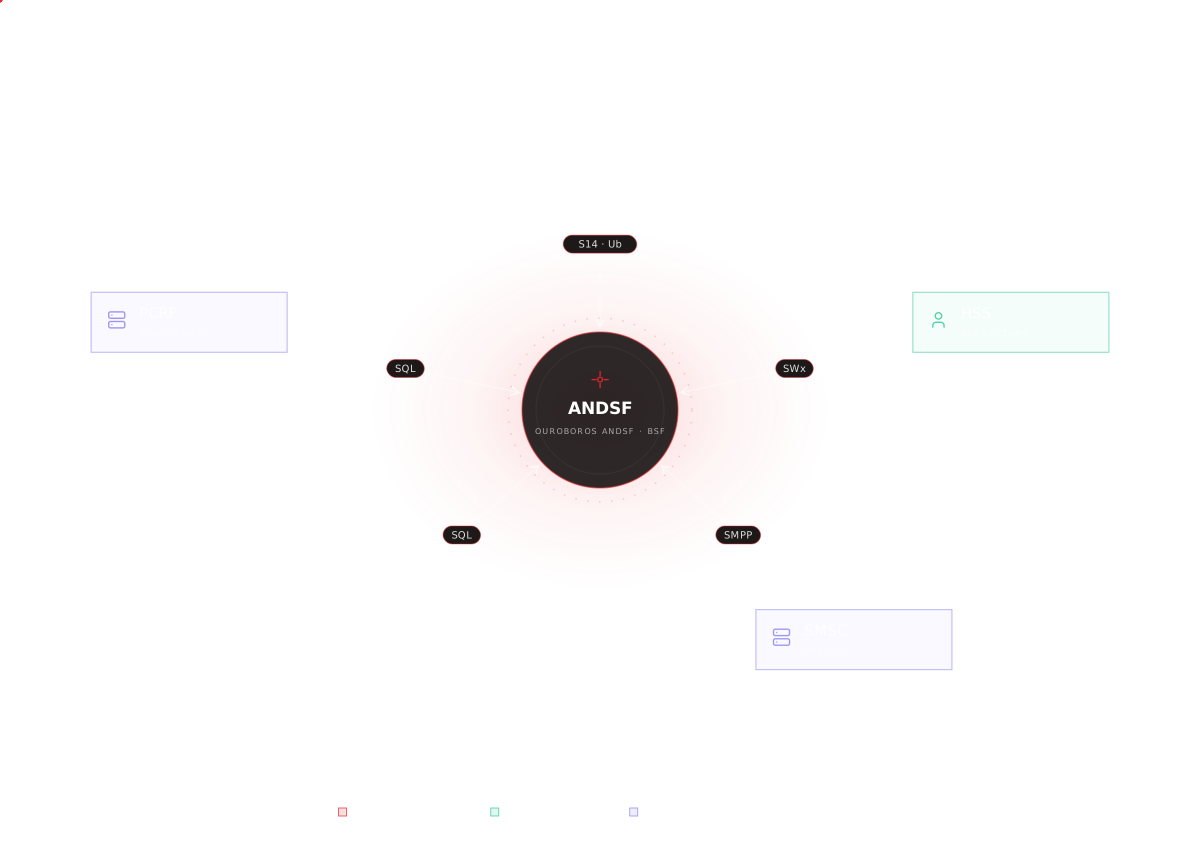
ANDSF · BSF — access steering policies for LTE and Wi-Fi
Dense-area offload, VoWiFi, roaming, time and area steering, IoT — one steering policy.
Wi-Fi offload in dense areas
Stadiums, stations, and city centres saturate LTE cells. The ANDSF steers best-effort traffic to operator hotspots and protects LTE capacity for subscribers who need it.
VoWiFi and indoor coverage
Subscribers at home or in the office are steered to the right Wi-Fi network for VoWiFi, with the operator choosing which hotspots are trusted.
Roaming policies
Roaming subscribers receive dedicated rules: partner hotspots preferred, data offloaded where it costs less.
Time-based and area-based steering
Policies change by time of day and by location, following the real traffic pattern of the network.
IoT devices
Connected devices receive their access rules over the air, without manual configuration on site.

We've selected Ouroboros because it was the best company capable of fulfilling our need for a scalable and virtualised full MVNO platform. Moreover, the Ouroboros team is pragmatic, flexible and responsive.
Pascal Prot
CEO-CTO · Legos
ANDSF and BSF in one node
The bootstrapping function is co-located with the ANDSF. No separate GBA infrastructure to deploy, and fast key retrieval for every device.
Zero-touch device security
Keys are derived from the USIM, with authentication vectors generated by the HSS. Nothing to install or manage on devices, and subscriber secrets never leave the HSS.
Complete policy set
Inter-system mobility, routing, discovery, and Wi-Fi selection policies are supported. The operator controls access choice for every type of traffic, not only for the whole device.
Context-aware rules
Policies depend on the cell, the area, the time of day, and roaming. Steering follows the real load of the network.
Over-the-air updates
Policy changes are pushed to devices by SMS. A new rule is live in the field in minutes.
Shared subscriber data
SQL provisioning is shared with the Ouroboros HSS and PCRF. No new subscriber database, and an open API for CRM and OSS integration.
5G SA ready
In 5G SA, route selection policies are delivered by the Ouroboros PCF through the AMF, while the ANDSF keeps serving 4G devices. Access steering continues through the migration to 5G.
IPv4, IPv6 and dual-stack
Every interface runs over IPv4, IPv6 or both. The element fits an IPv6 core or a mixed network without a separate configuration.
Wi-Fi offload only pays off when devices actually use the right network. The Ouroboros ANDSF brings the policies, the security, and the subscriber data together: the BSF is built in, keys come from the USIM, and the subscriber records are the ones the HSS and PCRF already use. There is no new database and nothing to configure by hand on devices.
It runs on the AMTP platform, in production since 2004, with geographic and local redundancy, on COTS servers or virtualised infrastructure.
OPEX rental is available.

Tell us about your hotspot footprint, your LTE hot spots, and your VoWiFi plans. We'll propose the steering policies and an ANDSF deployment to match, on OPEX or CAPEX.
 Product datasheet
4G / LTE · 4G/LTE
Access Network Discovery and Selection Function (ANDSF)
Your subscribers' devices decide on their own whether to use LTE or Wi-Fi — and they often decide badly. The ANDSF tells them which network to use, where, when, and for which traffic.
In production since 2026 · Shares the HSS subscriber data · 99.999% availability
Wi-Fi capacity you paid for, and nobody uses
Operators deploy Wi-Fi hotspots to offload data from LTE and to improve indoor coverage for VoWiFi. But a handset left to itself picks networks on signal strength alone. It sticks to a congested cell when a hotspot is next door, or jumps onto a weak public Wi-Fi in the middle of a call.
Steering devices requires policies pushed to the device, and those policies must be delivered securely. Most solutions mean another subscriber database to provision, and passwords or certificates to manage on millions of devices.
The right access, for the right traffic, at the right time.
Access policies pushed to the device
The Access Network Discovery and Selection Function tells mobile devices which access network to use, when, and for which traffic: LTE, operator Wi-Fi hotspots, or direct Internet offload. Policies are delivered to the device over S14 and updated over the air. They can be defined per cell, per area, per time of day, and for roaming: video goes to Wi-Fi in a stadium during matches while voice stays on LTE, or roaming subscribers prefer partner hotspots.
Security from the USIM
The Ouroboros ANDSF integrates a Bootstrapping Server Function (BSF): the device and the ANDSF share a key derived from the USIM (GBA), with no password or certificate on the device. The authentication vectors are generated by the HSS over SWx, so subscriber secrets never leave the HSS, and the co-located BSF keeps key retrieval fast and simple to operate.
One subscriber database
Subscriber and identity data are shared with the Ouroboros HSS and PCRF. There is one point of provisioning and one database to access. Over-the-air updates are pushed to devices by SMS, so a policy change reaches the field in minutes.
ANDSF · BSF — access steering policies for LTE and Wi-Fi
How operators use it.
Dense-area offload, VoWiFi, roaming, time and area steering, IoT — one steering policy.
Wi-Fi offload in dense areas
Stadiums, stations, and city centres saturate LTE cells. The ANDSF steers best-effort traffic to operator hotspots and protects LTE capacity for subscribers who need it.
VoWiFi and indoor coverage
Subscribers at home or in the office are steered to the right Wi-Fi network for VoWiFi, with the operator choosing which hotspots are trusted.
Roaming policies
Roaming subscribers receive dedicated rules: partner hotspots preferred, data offloaded where it costs less.
Time-based and area-based steering
Policies change by time of day and by location, following the real traffic pattern of the network.
IoT devices
Connected devices receive their access rules over the air, without manual configuration on site.
Specifications.
Inside the platform.
ANDSF and BSF in one node
The bootstrapping function is co-located with the ANDSF. No separate GBA infrastructure to deploy, and fast key retrieval for every device.
Zero-touch device security
Keys are derived from the USIM, with authentication vectors generated by the HSS. Nothing to install or manage on devices, and subscriber secrets never leave the HSS.
Complete policy set
Inter-system mobility, routing, discovery, and Wi-Fi selection policies are supported. The operator controls access choice for every type of traffic, not only for the whole device.
Context-aware rules
Policies depend on the cell, the area, the time of day, and roaming. Steering follows the real load of the network.
Over-the-air updates
Policy changes are pushed to devices by SMS. A new rule is live in the field in minutes.
Shared subscriber data
SQL provisioning is shared with the Ouroboros HSS and PCRF. No new subscriber database, and an open API for CRM and OSS integration.
5G SA ready
In 5G SA, route selection policies are delivered by the Ouroboros PCF through the AMF, while the ANDSF keeps serving 4G devices. Access steering continues through the migration to 5G.
IPv4, IPv6 and dual-stack
Every interface runs over IPv4, IPv6 or both. The element fits an IPv6 core or a mixed network without a separate configuration.
Wi-Fi offload only pays off when devices actually use the right network. The Ouroboros ANDSF brings the policies, the security, and the subscriber data together: the BSF is built in, keys come from the USIM, and the subscriber records are the ones the HSS and PCRF already use. There is no new database and nothing to configure by hand on devices.
It runs on the AMTP platform, in production since 2004, with geographic and local redundancy, on COTS servers or virtualised infrastructure.
OPEX rental is available.
ePDG & AAA
The ePDG connects the devices steered to Wi-Fi to the packet core for VoWiFi and data.
Home Subscriber Server (HSS)
Generates the authentication vectors for the BSF over SWx and shares the subscriber data with the ANDSF.
PCRF
Shares the subscriber data with the ANDSF; its 5G counterpart, the PCF, delivers route selection policies in 5G SA.
Policy Control Function (PCF)
Delivers route selection policies to 5G SA devices through the AMF.
Next step
How much of your Wi-Fi capacity do your subscribers actually use?
Tell us about your hotspot footprint, your LTE hot spots, and your VoWiFi plans. We'll propose the steering policies and an ANDSF deployment to match, on OPEX or CAPEX.