A subscriber's balance should not depend on which radio carried the session. The Ouroboros CHF charges 5G SA data with the same rating engine, the same tariffs, and the same accounts as the OCS that already charges 2G, 3G and 4G.
5G SA introduces a new charging interface. The SMF no longer speaks Diameter Gy; it calls a Charging Function over the Service Based Interface. Many operators answer with a new charging product dedicated to 5G, alongside the OCS that charges voice, SMS and LTE data.
The result is two rating engines and two sets of tariffs for the same customer. A data bundle bought on 4G must be visible on 5G. A balance consumed on a 5G session must stop a 4G session at zero. Every product launch is configured twice, and every inconsistency between the two systems becomes either revenue leakage or a customer complaint.

N40 charging of 5G sessions
The CHF is the charging entry point of the 5G core. When a subscriber opens a PDU session, the SMF requests charging over N40: it creates the charging data, reports usage per rating group as the session runs, and releases it at the end. The CHF reserves quota, rates usage, and debits the account in real time for prepaid subscribers, or records it for postpaid billing.
Part of the Ouroboros OCS
The Ouroboros CHF is part of the Ouroboros OCS. 5G converged charging requests are rated by the same engine and on the same accounts as the Diameter Ro and Gy requests of the 2G, 3G and 4G network. The rating engine and database are also those of the Ouroboros SCP for 2G voice. One billing point serves every generation.
Per-application rating
Inside the Converged Charging System, the CHF combines account balance management, rating, and the charging gateway function. Rating groups map to service keys in the database, so each application or flow can have its own rate. With the Deep Packet Inspection of the Ouroboros UPF and the application rules of the Ouroboros PCF, an application can be zero-rated or charged at a specific tariff. Subscriber identity comes from the Ouroboros HLR/HSS UDR: one provisioning point for the whole network.
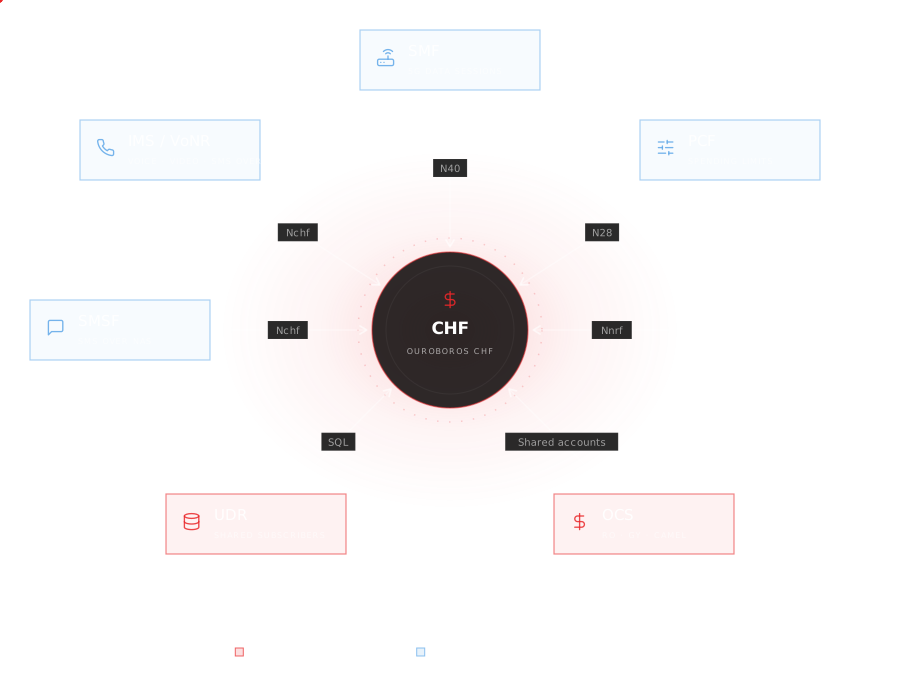
CHF — 5G converged charging on the OCS rating engine
5G launch on existing charging, convergent prepaid and postpaid, per-application tariffs, wallets, MVNE — one rating engine.
5G SA launch on the existing charging
An operator running the Ouroboros OCS adds 5G SA. Existing tariffs, bundles and balances apply to 5G PDU sessions from the first day, without a second charging product.
Convergent prepaid and postpaid
Prepaid and postpaid subscribers are charged by the same platform. Several subscriber classes carry different rate plans, with unlimited rate plans per operator.
Per-application tariffs and zero rating
A video or messaging application is zero-rated, or charged on its own rating group, using application detection from the UPF and rules from the PCF.
Multiple wallets
Time, currency and special wallets coexist on the same account. A data bundle, a promotional balance, and the main balance are consumed in the order the operator defines.
MVNE hosting several brands
A multi-tenant CHF hosts several MCC/MNC and number ranges, each brand with its own tariffs, on one charging platform.
We've selected Ouroboros because it was the best company capable of fulfilling our need for a scalable and virtualised full MVNO platform. Moreover, the Ouroboros team is pragmatic, flexible and responsive.
Pascal Prot
CEO-CTO · Legos
One rating engine from 2G to 5G
The CHF uses the rating engine and database of the Ouroboros OCS and SCP. A tariff or a bundle is defined once and charged the same way on every generation.
Shared accounts across sessions
5G sessions debit the same balances as 4G data, IMS voice and 2G calls. No double-spending between generations, no reconciliation between two charging systems.
Per-application rating
Rating groups map to service keys, combined with UPF application detection and PCF rules. Operators launch zero-rated applications and application bundles as configuration.
Prepaid and postpaid convergence
Online and offline charging run on the same platform. One system covers every subscriber type and every offer.
Maximum duration per time slice
Quota is granted per time slice to secure the maximum usage of each session. Prepaid exposure is capped even on long sessions.
Shared UDR
Subscriber identity comes from the repository shared with the HLR, HSS and UDM. One provisioning point; a new subscriber is chargeable immediately.
Account status notifications
Charging events can notify the subscriber of the account status by SMS. Low balance and bundle expiry reach the customer without a separate notification platform.
IPv4, IPv6 and dual-stack
Every interface runs over IPv4, IPv6 or both. The element fits an IPv6 core or a mixed network without a separate configuration.
5G charging is a new interface, not a new business. The Ouroboros CHF treats it that way: N40 is another entry point to the charging system the operator already runs, with the same tariffs, the same balances, and the same customer view.
Operators running the Ouroboros OCS gain 5G SA charging without a migration. Operators starting from scratch get one billing point for every generation from day one.
OPEX rental is available, so charging capacity can follow the subscriber base.

Tell us your current charging platform, your prepaid and postpaid mix, and your 5G SA plans. We'll show how 5G charging runs on the same tariffs and accounts, on OPEX or CAPEX.
 Product datasheet
2G to 5G · Charging & Billing
Charging Function (CHF)
A subscriber's balance should not depend on which radio carried the session. The Ouroboros CHF charges 5G SA data with the same rating engine, the same tariffs, and the same accounts as the OCS that already charges 2G, 3G and 4G.
In production since 2026 · 148M+ subscribers · 99.999% availability
A new charging system for every generation
5G SA introduces a new charging interface. The SMF no longer speaks Diameter Gy; it calls a Charging Function over the Service Based Interface. Many operators answer with a new charging product dedicated to 5G, alongside the OCS that charges voice, SMS and LTE data.
The result is two rating engines and two sets of tariffs for the same customer. A data bundle bought on 4G must be visible on 5G. A balance consumed on a 5G session must stop a 4G session at zero. Every product launch is configured twice, and every inconsistency between the two systems becomes either revenue leakage or a customer complaint.
One billing point for every generation.
N40 charging of 5G sessions
The CHF is the charging entry point of the 5G core. When a subscriber opens a PDU session, the SMF requests charging over N40: it creates the charging data, reports usage per rating group as the session runs, and releases it at the end. The CHF reserves quota, rates usage, and debits the account in real time for prepaid subscribers, or records it for postpaid billing.
Part of the Ouroboros OCS
The Ouroboros CHF is part of the Ouroboros OCS. 5G converged charging requests are rated by the same engine and on the same accounts as the Diameter Ro and Gy requests of the 2G, 3G and 4G network. The rating engine and database are also those of the Ouroboros SCP for 2G voice. One billing point serves every generation.
Per-application rating
Inside the Converged Charging System, the CHF combines account balance management, rating, and the charging gateway function. Rating groups map to service keys in the database, so each application or flow can have its own rate. With the Deep Packet Inspection of the Ouroboros UPF and the application rules of the Ouroboros PCF, an application can be zero-rated or charged at a specific tariff. Subscriber identity comes from the Ouroboros HLR/HSS UDR: one provisioning point for the whole network.
CHF — 5G converged charging on the OCS rating engine
How operators use it.
5G launch on existing charging, convergent prepaid and postpaid, per-application tariffs, wallets, MVNE — one rating engine.
5G SA launch on the existing charging
An operator running the Ouroboros OCS adds 5G SA. Existing tariffs, bundles and balances apply to 5G PDU sessions from the first day, without a second charging product.
Convergent prepaid and postpaid
Prepaid and postpaid subscribers are charged by the same platform. Several subscriber classes carry different rate plans, with unlimited rate plans per operator.
Per-application tariffs and zero rating
A video or messaging application is zero-rated, or charged on its own rating group, using application detection from the UPF and rules from the PCF.
Multiple wallets
Time, currency and special wallets coexist on the same account. A data bundle, a promotional balance, and the main balance are consumed in the order the operator defines.
MVNE hosting several brands
A multi-tenant CHF hosts several MCC/MNC and number ranges, each brand with its own tariffs, on one charging platform.
Specifications.
Inside the platform.
One rating engine from 2G to 5G
The CHF uses the rating engine and database of the Ouroboros OCS and SCP. A tariff or a bundle is defined once and charged the same way on every generation.
Shared accounts across sessions
5G sessions debit the same balances as 4G data, IMS voice and 2G calls. No double-spending between generations, no reconciliation between two charging systems.
Per-application rating
Rating groups map to service keys, combined with UPF application detection and PCF rules. Operators launch zero-rated applications and application bundles as configuration.
Prepaid and postpaid convergence
Online and offline charging run on the same platform. One system covers every subscriber type and every offer.
Maximum duration per time slice
Quota is granted per time slice to secure the maximum usage of each session. Prepaid exposure is capped even on long sessions.
Shared UDR
Subscriber identity comes from the repository shared with the HLR, HSS and UDM. One provisioning point; a new subscriber is chargeable immediately.
Account status notifications
Charging events can notify the subscriber of the account status by SMS. Low balance and bundle expiry reach the customer without a separate notification platform.
IPv4, IPv6 and dual-stack
Every interface runs over IPv4, IPv6 or both. The element fits an IPv6 core or a mixed network without a separate configuration.
5G charging is a new interface, not a new business. The Ouroboros CHF treats it that way: N40 is another entry point to the charging system the operator already runs, with the same tariffs, the same balances, and the same customer view.
Operators running the Ouroboros OCS gain 5G SA charging without a migration. Operators starting from scratch get one billing point for every generation from day one.
OPEX rental is available, so charging capacity can follow the subscriber base.
Online Charging System (OCS)
The CHF is part of the OCS. Diameter and 5G requests are rated by the same engine on the same accounts.
Session Management Function (SMF)
The SMF sends the charging requests of every PDU session to the CHF over N40.
Policy Control Function (PCF)
The PCF sets the charging decisions (rating groups, online or offline) applied by the CHF.
User Plane Function (UPF)
Application detection on the UPF enables per-application rating in the CHF.
Next step
Will 5G SA need a second charging system?
Tell us your current charging platform, your prepaid and postpaid mix, and your 5G SA plans. We'll show how 5G charging runs on the same tariffs and accounts, on OPEX or CAPEX.